
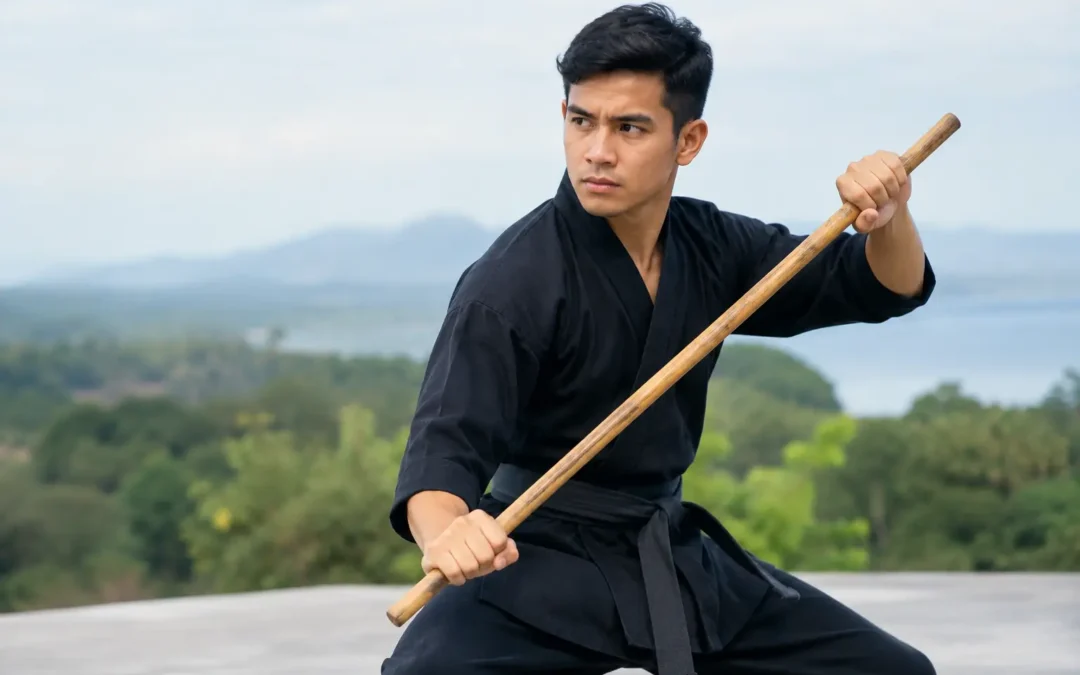
A Filipino martial arts basics guide should begin with one reassuring truth: you do not need prior fighting experience, exceptional fitness or a background in weapons to start. You need patient coaching, sensible safety standards and a willingness to practise the fundamentals. The first lessons are not about looking impressive. They are about learning to move with awareness, control your body and train confidently alongside others.
Filipino martial arts are practical, energetic and highly adaptable. For children, teenagers and adults, they can offer a fresh route into fitness, focus and self-belief. They also teach a valuable lesson that applies far beyond the training floor: staying calm, making good decisions and using control are more powerful than panic.
What are Filipino martial arts?
Filipino martial arts is an umbrella term for fighting systems developed in the Philippines. You may hear them called Eskrima, Arnis or Kali. The names, techniques and training methods can vary between lineages, so there is no single version that every instructor teaches in exactly the same way.
What many systems share is a strong focus on weapons training, especially sticks, alongside empty-hand defence, movement, timing and awareness. A beginner may work with padded training sticks from an early stage, but this is not about encouraging aggression. Proper instruction puts safety, respect and controlled practice first.
Training with a stick can actually make some fundamentals easier to understand. The weapon gives you a clear reference point for distance, angles and positioning. Over time, the same principles can transfer to open-hand movements, everyday objects and personal safety awareness.
Filipino martial arts basics: the skills you learn first
Beginners do not need to memorise a long catalogue of techniques. Good training builds a reliable base first, then adds detail as confidence grows. That matters because a complicated movement is of little use if your balance disappears as soon as you try it under pressure.
Stance, posture and balance
Your stance is the platform for everything else. You will learn to stand in a way that lets you move forwards, backwards and sideways without crossing your feet or becoming rooted to the spot. Knees stay soft, posture stays upright and your hands remain in a useful position rather than dropping by your sides.
This may sound simple, but it is where stronger movement begins. Better balance helps a child feel more coordinated, gives a teenager a physical outlet with purpose and enables an adult to train more safely as fitness improves.
Footwork and distance
Filipino martial arts place real value on footwork. Rather than meeting force head-on, you learn to step to safer angles, manage space and avoid being directly in front of an incoming line.
Distance is just as important. If you are too close, you may not have room to react. Too far away, and you cannot apply a technique effectively. Beginners learn to recognise different ranges gradually: long range, where the stick is most useful; closer range, where control and positioning become more important; and empty-hand range.
This is one reason Filipino martial arts are so engaging. Your feet are never an afterthought. Every movement has a reason.
Angles of attack and defence
Many programmes use a numbered angle system to teach striking lines. The exact number and pattern can differ between schools, but the purpose is consistent: to help students recognise where an attack is travelling and respond with a clear, practised action.
At first, you may practise a small set of strikes slowly with a partner or on pads. You will also learn defensive movements such as covers, blocks, parries and evasive steps. The goal is not to freeze and hope for the best. It is to develop awareness of direction, timing and control.
A good coach will make the distinction clear: training drills are not a guarantee of what will happen in a real confrontation. Real-world self-defence includes avoidance, communication, escape and getting help. Physical skills sit within that bigger picture.
The live hand
One feature that often surprises new students is the use of the non-weapon hand, sometimes called the live hand. It is not left hanging uselessly. It can protect, check, guide, control distance or help create a safer route away.
This develops coordination because each side of the body has a job to do. Beginners usually start slowly, and that is exactly right. Speed without control creates sloppy habits. Controlled repetition builds the confidence to move naturally later.
Partner drills and timing
Filipino martial arts are often learned through partner drills. These are structured exchanges where both people know the pattern and can concentrate on rhythm, accuracy and safe positioning. You may see a drill repeated from one side and then the other, building coordination step by step.
Partner work should never mean being thrown in at the deep end. At a well-led academy, students begin at an appropriate pace, use suitable equipment and learn how to be good training partners. That means listening, pulling power when required and helping one another improve.
Why weapons training can be safe for beginners
The word “weapons” can make some parents and first-time students pause, understandably. In a professional class, beginners do not begin with uncontrolled sparring or dangerous contact. Training tools, protective equipment, supervision and clear rules are there to make practice purposeful and safe.
Safety starts before the first drill. Students learn how to hold and carry equipment responsibly, how much space to leave around others and when to stop. They work at a manageable speed, often using solo patterns, focus pads or carefully structured partner sequences before anything more demanding is introduced.
The trade-off is that progress can feel slower than copying flashy moves online. That slower route is the right one. It creates discipline, builds trust and gives techniques a stronger foundation.
What Filipino martial arts can do for confidence and fitness
The physical benefits are easy to see. Regular training can improve coordination, cardiovascular fitness, mobility, grip strength and whole-body movement. Because drills ask you to think while you move, they can also sharpen concentration and reactions.
The less obvious benefits are often the ones families value most. A quiet child may begin speaking more clearly, taking turns with confidence and persevering when a pattern feels difficult. A teenager may find a positive way to manage stress and channel energy. Adults can enjoy a challenging session that takes their attention away from work pressures while building genuine capability.
Confidence does not come from being told you are confident. It grows when you practise something difficult, improve through effort and recognise that you can stay composed when things do not go perfectly. That is the kind of progress martial arts can make visible week by week.
Your first Filipino martial arts class
Wear comfortable sports clothing, bring water and arrive ready to learn rather than ready to prove anything. You do not need to buy specialist kit before you understand the programme. Your instructor should explain what equipment is needed, when it is needed and how progression works.
Expect the session to include a warm-up, movement practice, technical instruction and a cool-down. You may work on simple strikes, footwork patterns or pad drills before trying a partner exercise. Ask questions if you are unsure. Good martial arts training welcomes curiosity because clear understanding keeps everyone safer.
For parents, the best children’s class is not necessarily the loudest or toughest-looking one. Look for age-appropriate coaching, consistent boundaries, encouragement and a structure that helps each child develop at their own pace. For adults, look for a supportive environment where beginners are treated with respect and challenged sensibly.
At Kane Academy, Filipino martial arts training is approached as more than learning techniques. It is an opportunity to build fitness, resilience, self-control and a stronger connection to a supportive community.
Start where you are. A steady stance, a well-timed step and the confidence to keep practising can become the foundation for far more than a martial arts skill.