
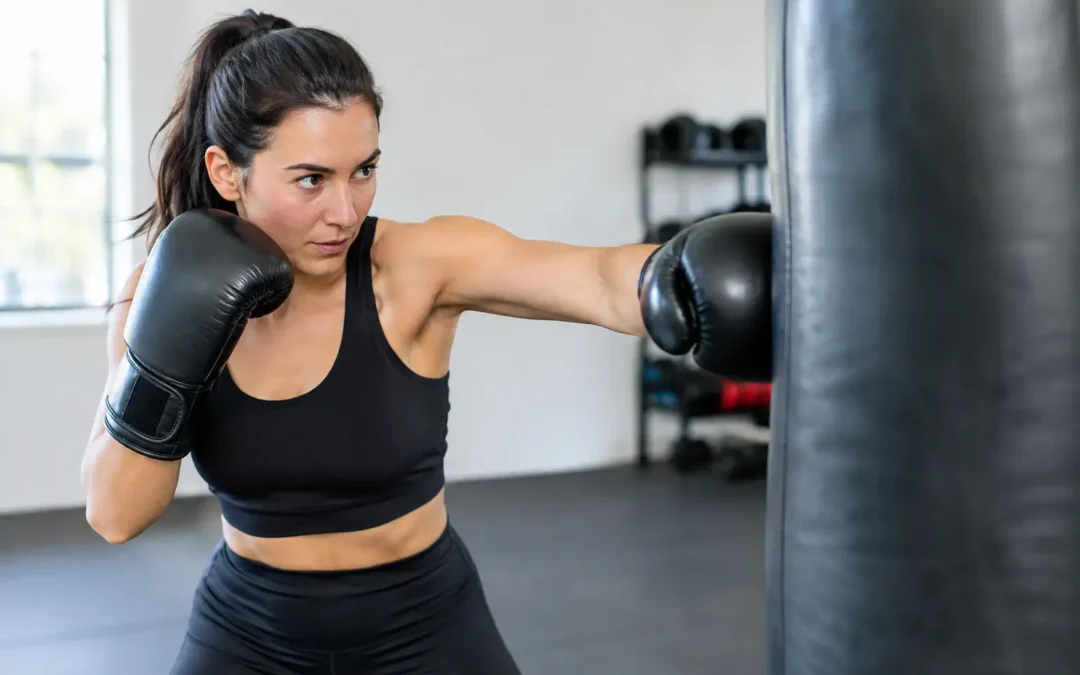
You do not need to arrive fit, flexible or fearless to start adult kickboxing. You only need to be willing to take the first class. For many adults, that first session is the moment exercise stops feeling like a chore and starts feeling purposeful: you are working hard, learning a skill and proving to yourself that you can do more than you thought.
Adult kickboxing is not reserved for people who have trained before or who want to compete. It is a practical, energising way to build fitness, learn effective self-defence and find a positive routine that carries into the rest of your week.
What adult kickboxing can give you
A good kickboxing class trains the whole body. Punching combinations develop your upper-body endurance and coordination, while kicks, footwork and movement challenge your legs, core and balance. Padwork raises your heart rate quickly, but it has a focus that a treadmill often lacks. You are not simply counting down the minutes. You are learning to move with control, react to instruction and improve one combination at a time.
That makes kickboxing a strong choice if your usual fitness routine has become repetitive. The session can be demanding, but the learning element keeps your mind engaged. You may leave tired, yet clearer-headed than when you arrived.
There is also a difference between feeling generally fit and feeling physically capable. As your technique develops, you begin to stand more confidently, move with better awareness and understand how to generate power without relying on brute strength. These are useful benefits for adults of every age and background.
The results are not only physical. Training regularly asks you to show up when work has been stressful, when motivation is low and when progress feels slow. Each class is a small act of discipline. Over time, that consistency can build real resilience.
You can start as a complete beginner
One of the biggest barriers for adults is the idea that everyone else in the class will be experienced. In a properly structured beginner programme, nobody expects you to know the terminology, throw perfect kicks or remember every combination on day one.
Your early sessions should focus on foundations: stance, guard position, safe movement, basic punches, introductory kicks and how to hold pads responsibly for a partner. Coaches break techniques down so you can understand not just what to do, but why it matters. A stable stance improves balance. A raised guard helps protect you. Controlled hip movement makes a kick more effective and reduces the temptation to force it.
Speed comes later. Power comes later too. Getting the basics right first is what gives you a safer, more confident route forward.
It is normal to feel a little self-conscious at the beginning. Most people do. The good news is that everyone in the room has had a first class, and a welcoming martial arts community remembers what that feels like. You will be encouraged to work at your level, ask questions and celebrate progress that might not be obvious to anyone else.
Fitness with a skill attached
There are plenty of ways to get sweaty. What makes kickboxing different is that your fitness improves alongside a practical skill.
A typical class may include a warm-up, mobility work, technical coaching, pad drills, combinations and conditioning. The exact balance depends on the session and your experience level, but the structure gives your effort a clear direction. Rather than doing endless exercises for their own sake, you are preparing your body to move better and apply what you are learning.
This can make training easier to stick with. You may start because you want to lose weight, improve your stamina or get stronger. Then you notice that you are also enjoying the challenge of sharper footwork, cleaner combinations and the satisfaction of landing a technique correctly on the pads.
Progress is personal. One person may be motivated by improved cardiovascular fitness, while another wants greater confidence after a difficult period or a positive outlet after a desk-bound day. Adult kickboxing can support all of these goals, but it works best when you allow yourself time. Training twice a week may bring faster technical progress than once a week, but a consistent weekly session is far more valuable than an ambitious plan you cannot maintain.
Learning self-defence without the hype
Practical self-defence is about more than throwing punches and kicks. It begins with awareness, judgement, posture and the ability to create space. It also means understanding that the safest outcome is always to avoid danger where possible and leave a situation rather than escalate it.
Kickboxing gives you useful physical tools. You learn distance, balance, coordination and how your body responds under pressure. Pad training can help you develop decisive movement and controlled power. Yet responsible self-defence training also teaches restraint. Capability and accountability belong together.
That balance matters. Training should make you feel empowered, not encourage you to take unnecessary risks. A supportive academy will treat self-defence as a practical life skill, delivered with care, control and respect for others.
Confidence is built through repetition
Confidence rarely appears as one dramatic breakthrough. More often, it grows quietly. It is the first time you complete a full session when you thought you would need to stop. It is remembering a combination without being prompted. It is noticing that the movements which once felt awkward now feel natural.
Martial arts gives adults a clear way to see that growth. There are techniques to learn, goals to work towards and, in many programmes, gradings that recognise consistent effort and development. A belt or certificate is not the whole point, but it can mark a meaningful achievement: you committed, practised and earned your progression.
The confidence developed in class can show up elsewhere too. Members often find that they carry themselves differently at work, speak up more readily or approach new challenges with less hesitation. You are not pretending to be confident. You have evidence that you can learn difficult things.
The right environment makes a difference
Not every adult wants the same training experience. Some want a high-energy fitness focus. Others are looking for structured martial arts progression, practical self-defence or a new social outlet. The strongest classes make room for different goals while keeping standards high.
Look for coaching that is clear, patient and technically credible. You should be corrected without being made to feel embarrassed, pushed without being overwhelmed and welcomed without being patronised. Training partners matter too. A respectful class culture makes it easier to learn, particularly when you are new to padwork or working at close range.
At Kane Academy, adult training is built around that combination of challenge and support. Members can work towards stronger fitness and practical skills in a community that values kindness, accountability and continual growth alongside disciplined instruction.
What to expect from your first few classes
Your first session may feel like a lot to take in, and that is completely normal. Focus on listening, keeping your movements controlled and enjoying the process. You do not need expensive kit to begin. Comfortable training clothes, a water bottle and a willingness to learn are usually enough for an introductory class, with guidance available on suitable equipment as you progress.
You may feel muscles you have not used for a while, particularly through your shoulders, legs and core. Recovery matters. Drink water, get enough sleep and avoid judging your ability by one tough session. A little soreness can be expected when you start a new activity, but sharp pain or ongoing discomfort should always be raised with your coach and, where needed, a health professional.
Most importantly, do not compare your chapter one with somebody else’s chapter twenty. The person throwing fast, confident combinations has spent time practising the fundamentals you are beginning to learn.
Make the first class count
Adult kickboxing rewards the decision to begin, not the need to be perfect. Whether you want to crush a fitness goal, release stress after work, learn to defend yourself or simply do something that is for you, training can give your week fresh momentum.
Start at your own pace, stay consistent and let each session show you what you are capable of becoming.