
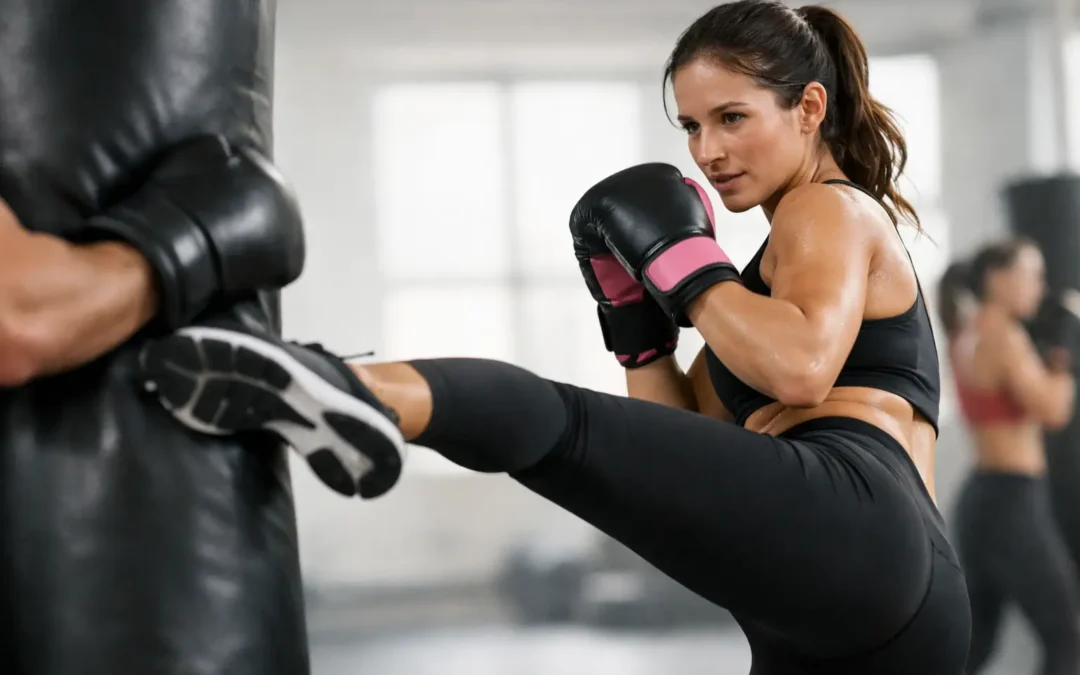
A powerful roundhouse kick is satisfying. So is finishing a class knowing you showed up for yourself, worked hard and learned something new. The best benefits of women’s kickboxing go far beyond burning calories or hitting pads. They reach into how you carry yourself, handle pressure and feel in your own body.
For many women, taking that first step into a martial arts class can feel daunting. You might worry that you are not fit enough, coordinated enough or experienced enough. The truth is that a well-led women’s kickboxing class is built for beginners as well as experienced students. You do not need to arrive confident. Training is one of the ways confidence is built.
Why women’s kickboxing feels different
Kickboxing gives your training a purpose. Instead of simply repeating exercises because a machine tells you to, you learn skills: stance, movement, punches, kicks, blocks and combinations. Every session gives you something practical to improve, whether that is keeping your guard up, finding better balance or putting together a sharper sequence on the pads.
That sense of progress matters. Fitness can feel frustrating when the only measure is a number on a scale. In kickboxing, you can notice changes in what your body can do. A combination that once felt awkward starts to flow. You recover more quickly between rounds. You hold your posture when you are tired. Those small wins build momentum.
A women’s-only class can also remove a common barrier for people who feel self-conscious starting out. It creates room to ask questions, make mistakes and train at your own level alongside women with similar goals. Some come for fitness, some for self-defence, some for stress relief and some simply because they want an activity that is theirs. All are valid reasons to begin.
The best benefits of women’s kickboxing
Stronger, more useful fitness
Kickboxing is a full-body workout. Punches engage the shoulders, arms and core; kicks ask for strength through the legs and hips; footwork challenges coordination and stamina. Pad drills and controlled combinations can raise the heart rate quickly, while technical work rewards control rather than rushing.
The result is fitness that feels useful. You may develop greater cardiovascular endurance, improved balance, mobility, core strength and coordination. These changes can support everyday life too, from carrying shopping and climbing stairs to feeling more energetic during a busy week.
How hard the workout feels depends on the class structure and your own starting point. A beginner does not need to train at maximum intensity to gain results. Good coaching provides options, helps you develop safe technique and encourages steady progression. Consistency is more valuable than trying to prove everything in your first session.
Confidence that is earned, not performed
Confidence is not about being the loudest person in the room. It is the quiet knowledge that you can learn, adapt and keep going when something feels difficult. Kickboxing creates regular opportunities to practise exactly that.
At first, remembering a simple punch-kick combination may take concentration. Later, you may be asked to move, defend and respond while staying calm. Each challenge is manageable because it is taught in stages. When you see yourself cope with something that once seemed outside your comfort zone, your self-belief becomes more grounded.
This can be especially valuable for women who have spent years making themselves smaller, avoiding attention or doubting their physical capability. Training encourages you to take up space with good posture, make clear decisions and use your voice. You are not training to become aggressive. You are learning that being capable and assertive is a strength.
Practical awareness for personal safety
Women’s kickboxing can support personal safety by building awareness, movement and controlled physical skills. You may learn how to maintain distance, use a balanced stance, protect yourself with a guard and strike pads with purpose. Just as importantly, quality self-defence teaching should cover awareness, boundary-setting and recognising when the safest option is to leave a situation.
There is no class that can guarantee safety in every real-world situation. Self-defence is not about winning a fight, and it should never encourage unnecessary confrontation. The aim is to improve your options: notice risk earlier, communicate clearly, create space where possible and act decisively if you need to protect yourself.
Practising techniques with trained partners and coaches also helps replace panic with familiar action. Controlled repetition cannot recreate every situation, but it can make your body feel less foreign to you. That alone can change how you move through the world.
A healthier way to release stress
After a demanding day, hitting pads can be a brilliant reset. Kickboxing requires your attention. You cannot fully replay a difficult meeting or scroll through tomorrow’s to-do list while focusing on your stance, breathing and next combination.
The physical effort can help release built-up tension, while the rhythm of drills gives the mind a break from constant noise. Many students leave class tired but clearer, with a sense that the day has been put back into proportion.
It is not a replacement for professional support when stress, anxiety or low mood are overwhelming. However, regular movement, routine and positive social connection can be valuable parts of looking after your wellbeing. The key is choosing a class environment that challenges you without making you feel judged.
Discipline that carries into daily life
Kickboxing rewards the unglamorous habits that create long-term progress: arriving regularly, listening carefully, practising the basics and staying patient when improvement is gradual. There are no shortcuts around technique. A strong kick starts with stance, balance and control, not just force.
That discipline often follows students beyond the training floor. You may become better at setting aside time for yourself, sticking with goals or responding more calmly when plans do not work straight away. Grading pathways can add another source of motivation, giving you clear milestones to work towards and a genuine sense of achievement when you reach them.
A supportive community with shared goals
Training alongside others is different from working out alone. You share the effort of a tough round, hold pads for a partner and celebrate each other’s progress. Over time, familiar faces become encouragement on the days when motivation is low.
The right community does not depend on everyone being at the same fitness level. It makes space for beginners, celebrates effort and keeps standards high without creating an intimidating atmosphere. At Kane Academy, that balance of kindness, accountability and continual growth is central to the training experience.
For women with busy work, family or caring responsibilities, a regular class can become protected time. It is an hour where you are not only meeting everyone else’s needs. You are developing your own health, skills and confidence in a room that wants to see you succeed.
What to expect at your first women’s kickboxing class
Your first session should begin with a welcome, a warm-up and clear guidance on the basics. You are likely to practise a fighting stance, simple punches and kicks, and combinations on pads or shields. Classes may include fitness drills, but the focus should remain on learning safely and working at a level that suits you.
You do not need expensive equipment before you know whether kickboxing is right for you. Wear comfortable clothes you can move in, bring water and arrive ready to learn. Coaches can advise on gloves, hand wraps and any other kit when you decide to continue.
Expect to feel challenged, especially if it has been a while since you exercised. Expect to get something wrong occasionally too. That is not failure; it is the normal starting point for every skilled kickboxer. A good instructor will correct technique constructively, keep training controlled and help you build confidence one session at a time.
Is women’s kickboxing right for you?
If you want a fitness routine with more purpose, a practical route into self-defence or a confidence-building challenge, it could be an excellent fit. You do not need to be naturally sporty, and you do not need to want to compete. Many people train purely for the physical and personal benefits.
If you have an injury, a health condition or concerns about returning to exercise, speak to a qualified health professional first and let your instructor know. Training can often be adapted, but the right approach depends on the individual.
Your first class is not a test of whether you belong. It is an opportunity to try something that could make you feel stronger in more ways than one. Take the first step, learn the basics and give yourself time to grow.