
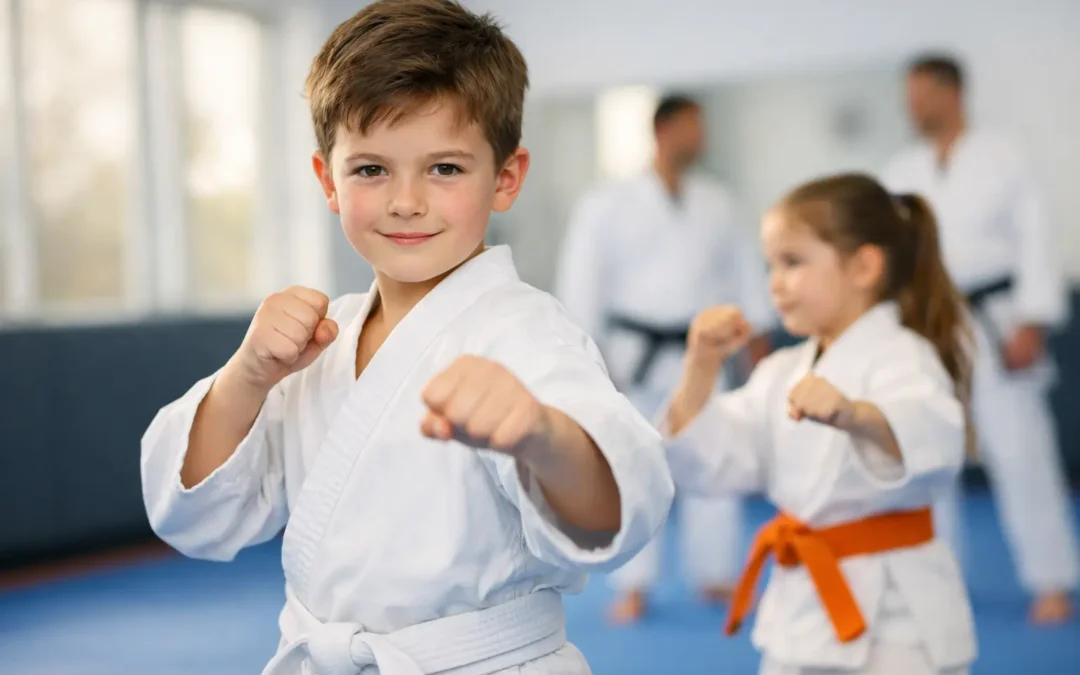
A child misses a kick, loses balance during a drill or finds a new movement frustrating. Their first instinct may be to stop. In a well-run martial arts class, that moment becomes something more useful: a chance to take a breath, listen, try again and notice that effort changes outcomes. That is how martial arts builds resilience in children – not through pressure or perfection, but through small, repeated experiences of overcoming difficulty.
For parents, resilience can sound like a big idea. In everyday life, it is often much simpler. It is a child returning to a task after getting it wrong. It is managing disappointment without falling apart. It is asking for help, accepting feedback and recognising that progress takes time. Martial arts gives children a structured, active place to practise those skills each week.
Resilience grows through manageable challenge
Children do not become resilient by being shielded from every hard moment, nor by being pushed into situations that overwhelm them. They need challenges that stretch them while still feeling safe and achievable. Martial arts training is built around this balance.
A new student may begin by learning a stance, a simple combination or how to hold pads safely with a partner. At first, the coordination can feel awkward. With clear coaching and repetition, the movement starts to make sense. The child has direct proof that something difficult can become familiar through practice.
This matters because children often make quick conclusions about themselves: “I’m no good at this” or “I can’t do it.” A positive martial arts environment helps replace that fixed thinking with a more helpful question: “What should I work on next?” The aim is not for every child to be the fastest, strongest or most naturally confident person in the room. It is for them to keep showing up and keep improving.
How martial arts builds resilience in children over time
Resilience is not created in one confidence-boosting class. It develops through routine. Weekly training gives children regular opportunities to follow instructions, practise skills and see the benefit of consistency.
Martial arts also makes progress visible. A child may remember struggling with a technique a few weeks earlier, then realise they can now perform it with control. They may move towards a grading, earn recognition for effort or take on a more advanced drill. These milestones matter, but the deeper lesson is that improvement is earned in the sessions between them.
For shy children, this steady rhythm can be particularly valuable. They do not need to become the loudest child in the class to grow in confidence. They can build it quietly – by joining in, making eye contact, holding pads for a partner or demonstrating a movement when they are ready. Being noticed for their effort, rather than judged for their personality, can make a real difference.
Setbacks become part of the process
No child enjoys getting something wrong. Yet setbacks are unavoidable, whether that is a tricky school task, a friendship problem or not making a team. Martial arts gives children a healthy way to experience mistakes in a controlled setting.
Perhaps a technique does not land correctly on the pads. Perhaps their timing is off during a partner drill. The coach corrects the detail, the child tries again, and the class moves forward. There is no need for embarrassment. Errors are information.
That approach can carry beyond the training floor. Children who learn that mistakes are a normal part of learning are often better able to cope when schoolwork becomes harder or plans do not work out. It does not mean they will never feel frustrated. It means frustration does not have to be the end of the attempt.
Discipline gives children something to rely on
Resilience is often mistaken for toughness alone. Real resilience also needs self-control, patience and dependable habits. Martial arts develops these qualities through clear expectations: listen carefully, respect others, train safely and give your best effort.
The structure is reassuring. Children know when it is time to line up, warm up, practise, work with a partner and cool down. For some, particularly children who find busy social settings difficult, that predictability can help them settle and participate. A class should still be energetic and enjoyable, but clear boundaries help children feel secure enough to take positive risks.
Discipline is not about demanding silence or obedience for its own sake. It is about helping children understand that their choices affect their own progress and the safety of the group. When they arrive prepared, focus during instruction and treat a partner with care, they become more accountable. That is a powerful form of independence.
Confidence is built through capability
Telling a child to “be confident” rarely works. Confidence tends to follow evidence. When a child learns how to move with balance, protect their personal space, use their voice and practise age-appropriate self-defence skills, they feel more capable in their body.
That capability is especially meaningful because martial arts is practical. Children are not simply talking about courage. They are learning to stay calm, make decisions and use controlled movement under guidance. The emphasis should always be on avoidance, awareness, respect and safety – never on encouraging conflict.
As children feel more capable, they often carry themselves differently. They may speak a little more clearly, try a new activity or find it easier to join a group. These changes are not guaranteed, and every child develops at their own pace. But when training is inclusive and patient, it can provide a reliable foundation for confidence.
Partners teach empathy as well as courage
Martial arts is not only an individual activity. Partner drills teach children how to work with people who may have different abilities, confidence levels and learning styles. They learn to take turns, hold pads properly, listen to boundaries and encourage someone else.
This is where resilience becomes more than personal determination. A resilient child can also stay kind when a partner is struggling, accept a correction without blaming someone else and contribute positively to the group. These social skills are useful in classrooms, friendships and family life.
At Kane Academy, a family-friendly class culture matters because children learn best when they feel they belong. A child should be challenged, but they should also know that coaches and classmates want them to succeed. That sense of community helps them keep going on days when confidence is low.
The role of the coach and the class environment
Not every martial arts programme builds resilience in the same way. The quality of coaching matters. Children need instructors who can set high standards while adapting their communication to the individual in front of them.
A confident child may respond well to a bigger challenge. A nervous beginner may need time to watch before joining in. A child with additional needs may benefit from clearer steps, more repetition or an adjusted drill. Inclusion does not mean lowering expectations. It means creating a route for each child to participate, develop and feel proud of their effort.
Parents can support this by choosing classes that are age-appropriate, structured and welcoming to beginners. Ask how coaches handle nerves, behaviour, partner work and progression. Look for a programme where safety and respect are treated as seriously as technique.
What parents can reinforce at home
The conversation after class can strengthen what children are learning. Rather than asking only, “Did you win?” or “Were you the best?”, try asking what felt difficult, what they practised or what they would like to improve next time.
Praise specific behaviours: turning up even when they felt nervous, listening closely, helping a partner or trying again after a mistake. This reinforces the idea that character is built through actions, not simply talent.
It also helps to keep expectations realistic. Some weeks, your child will come home buzzing with pride. Other weeks, they may feel tired, challenged or disappointed. Both experiences can be useful. The goal is not a permanently happy child who never struggles. It is a child who learns that they can meet struggle with support, effort and growing belief in themselves.
Give your child the chance to begin before they feel completely ready. A first class can be the start of stronger habits, new friendships and the quiet confidence to face the next challenge.