
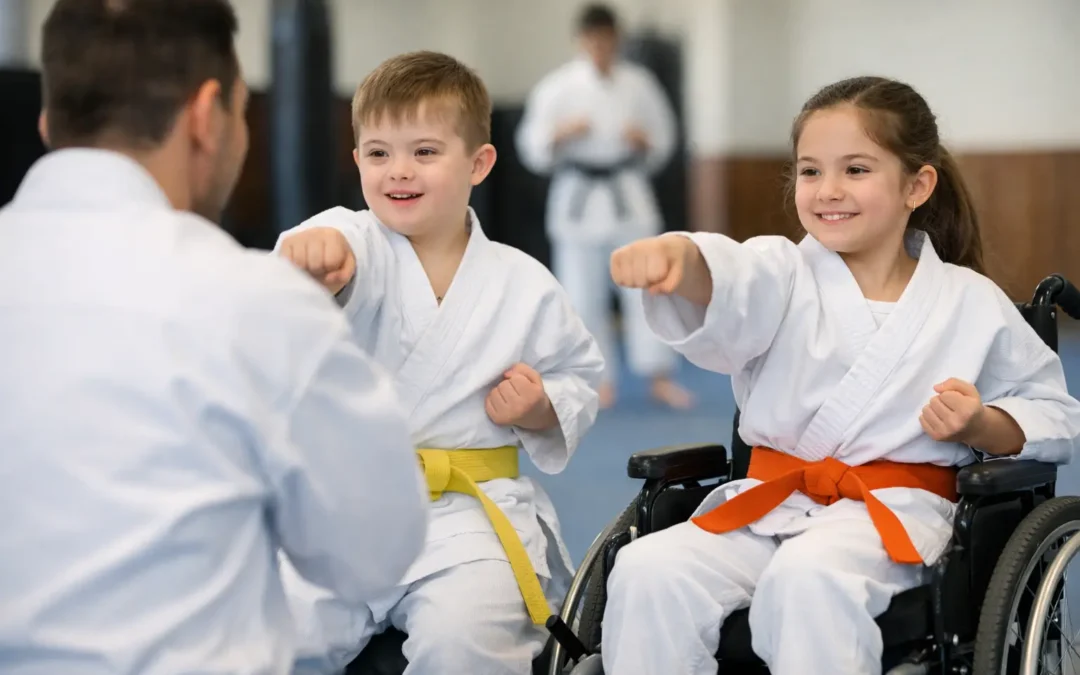
A child does not need to be loud, sporty or instantly comfortable in a busy group to benefit from martial arts. For many families, martial arts for children with additional needs offers something hard to find elsewhere: a positive routine where progress is noticed, effort matters and every small win can feel significant.
The right class is not about expecting every child to learn in the same way. It is about creating a safe, structured space where they can move, listen, practise, reset and grow at a pace that works for them. That may mean joining in with a whole drill one week, practising alongside a parent another, or simply feeling settled enough to return for the next session.
Why martial arts can be a positive fit
Martial arts gives children clear boundaries without making them feel boxed in. A class has a recognisable rhythm: arrive, line up, warm up, practise skills, listen to instructions and finish together. For children who benefit from predictability, that repeated structure can make a new environment feel more manageable over time.
There is also a powerful difference between being told to sit still and being given a purposeful way to move. Kickboxing-based drills, balance exercises, pads and age-appropriate self-defence skills can help children use their energy constructively. They are working towards a clear task, not simply being asked to burn off steam.
Success is often visible. A child can hold their stance for a little longer, remember a sequence, make contact with a pad or earn recognition for consistent effort. These moments build confidence because they are earned through practice. The message is simple: you can try, learn and improve.
That does not mean martial arts is the right activity for every child or every class will suit every family. Noise levels, group size, coaching style, transitions and sensory needs all matter. The best starting point is a conversation with an academy that listens carefully rather than making assumptions.
Martial arts for children with additional needs: what good support looks like
Inclusive coaching is not about lowering expectations. It is about making the route to progress clearer and more achievable. A skilled instructor can break a technique into smaller stages, demonstrate it visually, use simple language and give children enough time to process what they have heard.
Some children respond well to a clear countdown before a change of activity. Others may need a quieter explanation, a consistent place in the room or the option to watch before taking part. A child who finds eye contact difficult can still be listening. A child who needs a movement break is not necessarily disengaged. Patient coaching recognises these differences while keeping the whole class safe and purposeful.
At Kane Academy, the aim is for children to be known as individuals, not treated as a label. Parents understand their child better than anyone, so sharing useful information before a trial can help coaches plan a more comfortable first experience. It may be helpful to mention communication preferences, sensory sensitivities, mobility considerations, triggers, calming strategies and what success would look like for your child.
The academy can then explain honestly what support is available. This matters. Families deserve clarity about whether a class is suitable, how participation is managed and what adjustments are realistic within a group setting.
A class should feel challenging, not overwhelming
Martial arts involves listening, movement, physical contact and shared space. Those elements can be exciting, but they can also feel demanding. A supportive instructor will encourage a child to stretch their comfort zone without forcing them beyond it.
For one child, a useful challenge may be joining the warm-up. For another, it may be working with a partner, trying a new technique or coping with the sound of pads being hit. Progress is not always a straight line. Some weeks will feel easier than others, particularly after a change in routine, a difficult day at school or poor sleep.
The goal is steady participation, not perfection. When children learn that they can pause, regroup and try again, they are building resilience that reaches beyond the training floor.
Skills that can carry into everyday life
The physical benefits are real. Martial arts can support coordination, balance, body awareness, general fitness and healthy movement habits. Children practise using both sides of the body, controlling power and developing awareness of personal space.
Just as valuable are the life skills built into regular training. Children learn to wait for their turn, follow a sequence, respond to a coach, work alongside peers and keep going when something takes practice. These are not instant results, and they will look different for every child, but repetition gives those skills a chance to become familiar.
Confidence is often the change parents notice first. It is not about making a child the loudest person in the room. Real confidence can look like walking into class without hiding, asking for help, putting on their uniform independently or being proud to show a new skill at home.
Age-appropriate self-defence also teaches healthy boundaries. Children can learn about awareness, listening to trusted adults, using a clear voice and moving away from uncomfortable situations. Training should always reinforce control, respect and the responsibility that comes with learning martial arts skills.
How to prepare for a first class
A first session can go much more smoothly when the child knows what to expect. Explain that they will meet a coach, see other children training and be invited to try some movements. Avoid promising that it will be easy or that they must complete everything. Instead, make the goal simple: go in, have a look and try what feels manageable.
Comfortable clothing, a drink and arriving with enough time to settle can make a difference. If your child uses visual schedules, a short picture-based plan for the session may help. If they have a preferred calming item, ask the academy in advance whether it can be kept nearby.
Before the class, agree on a realistic definition of success. That could be staying for ten minutes, joining the warm-up, speaking to the instructor or returning next week. When success is measured by participation and courage rather than perfect technique, children are more likely to feel proud of their effort.
It is also useful to tell the coach what tends to work at home or school. A phrase that helps your child transition, a quiet signal for needing a break or a favourite reward after trying something new can give the instructor practical tools from the start.
Questions worth asking an academy
Parents should feel comfortable asking how instructors adapt their teaching, whether they can speak with a coach before booking, and what happens if a child becomes overwhelmed. Ask about class size, noise, waiting areas and whether a child can observe before joining in.
You may also want to know how progress is recognised. Gradings and certificates can be motivating, but they should never become a source of pressure. The right programme balances clear standards with encouragement and respects the fact that children may need different amounts of time to feel ready.
A trial session is valuable because it lets everyone learn. Your child can experience the space, the coach can see how they respond, and you can decide whether the environment feels right. One lesson may not answer every question, but it is a far better guide than guessing from a timetable alone.
Building consistency without pressure
Regular attendance helps children become familiar with the routine, faces and expectations. Yet consistency does not have to mean pushing through every difficult moment. If a child is struggling, speak to the instructor. A smaller goal for that session, extra time watching or a gradual return may be more useful than turning training into a battle.
Celebrate specific efforts: “You listened when the coach spoke”, “You came back after your break”, or “You tried that new stance.” Specific praise helps a child understand exactly what they did well. Over time, those small actions become proof that they are capable of more than they first believed.
The best martial arts journey gives a child room to be themselves while showing them what commitment can achieve. Start with a welcoming class, a patient conversation and one manageable step. Sometimes that first step becomes the routine where confidence, fitness and belonging begin to grow.