
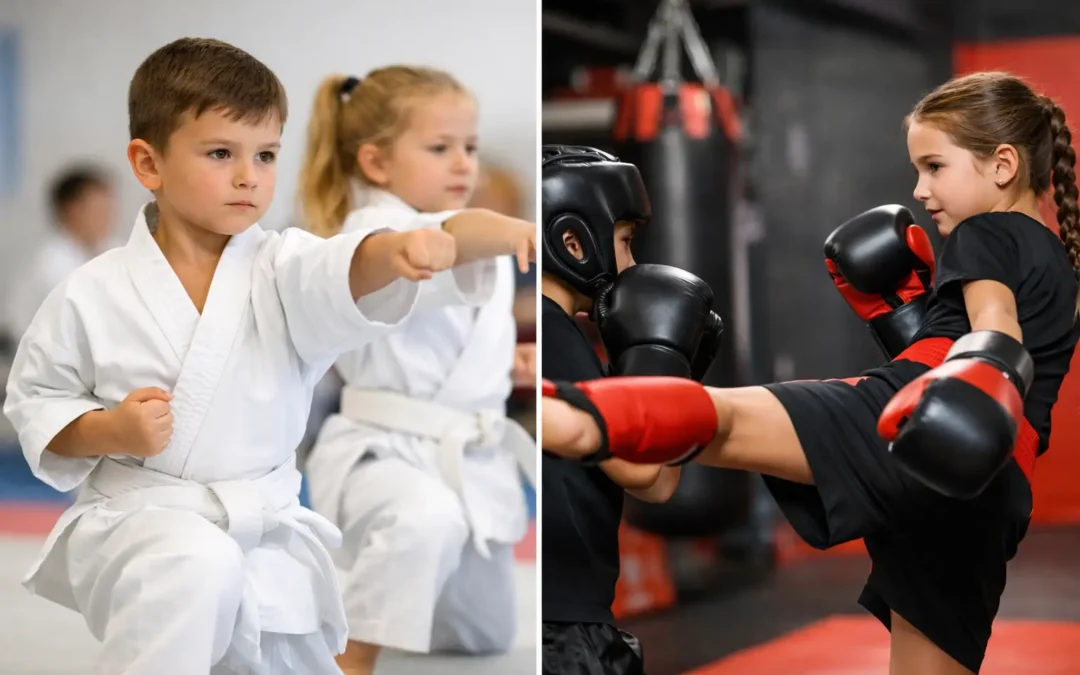
A child who is nervous about joining a new activity does not need to be pushed into the toughest-looking class. They need a place where they can learn, move, make friends and feel proud of what their body can do. That is why the question of children’s karate versus kickboxing is less about which style is “better” and more about which environment, teaching approach and class structure will help your child grow.
Both can teach discipline, coordination, confidence and respect. Both can give children a positive outlet for their energy. The real difference often lies in the way skills are taught, how classes feel and what keeps a child motivated enough to come back week after week.
Children’s Karate Versus Kickboxing: The Main Difference
Traditional karate is usually built around set techniques, stances, blocks, strikes and formal patterns. Children may spend time learning Japanese terminology, practising sequences and working towards coloured belt gradings. There is often a strong focus on precision, posture and following a recognised syllabus.
Children’s kickboxing classes generally focus on practical striking skills using punches, kicks, movement, pads and controlled partner drills. A well-run programme still has structure, rules and clear progression, but the sessions can feel more active and varied from the start. Children learn to move with purpose, develop balance and coordination, and build fitness while practising techniques in a safe, supervised setting.
Neither route automatically creates confidence or discipline. Great coaching does. A quiet child may love the calm repetition of karate patterns, while another may come alive when holding pads, learning combinations and celebrating a new skill with their training partners.
What Children Learn From Karate
Karate can be an excellent fit for a child who enjoys routine, detail and clearly defined goals. The formal structure helps many children understand that progress comes through patience and consistent practice. They learn to listen, wait their turn and focus on small improvements.
Patterns, often called kata, can be particularly satisfying for children who like to remember sequences and see their progress take shape. They may gain a strong sense of achievement from perfecting a stance, learning a new sequence or preparing for a grading.
The trade-off is that some children find long periods of repetition less engaging, especially when they are young or naturally high-energy. This does not mean karate is not for them, but it does mean the teaching needs to be age-appropriate, encouraging and active enough to hold their attention.
What Children Learn From Kickboxing
Kickboxing gives children a practical framework for developing movement, awareness and controlled striking. They might practise a simple punch-and-kick combination on pads, work on footwork games or learn how to keep a safe distance from a partner. The best children’s sessions make these skills fun without treating them as a game with no purpose.
This style can suit children who learn by doing. Hitting pads with correct technique gives immediate feedback: they can hear and feel when a strike lands well. That creates a powerful sense of capability, particularly for a child who has not yet found their confidence in team sports or the classroom.
Kickboxing is not about encouraging children to fight. In a professionally led class, it is about self-control. Children learn that strength means listening to instructions, respecting their partner, using the right level of contact and choosing calm responses outside the training space. Practical self-defence begins with awareness, boundaries and the confidence to seek help, not with trying to prove something.
Confidence Is Built Through Belonging
Parents often ask which martial art is best for a shy child. The honest answer is that the style matters less than whether the child feels safe enough to try. Confidence is built in small moments: walking into class, joining a warm-up, speaking a little louder, holding pads for someone else or getting back up after a technique does not work first time.
A supportive class gives children permission to be beginners. They should never be embarrassed for getting something wrong or compared harshly with the most athletic child in the room. Instead, coaches should notice effort, explain techniques clearly and set achievable challenges.
At Kane Academy, age-specific kickboxing programmes are designed around that principle. Younger children need movement, simple instructions and praise for positive behaviour. Older children are ready for greater technical focus, responsibility and goal-setting. In both cases, the aim is to help each child feel seen as part of a community, not lost at the back of a class.
Safety: What Parents Should Look For
Karate and kickboxing can both be safe activities for children when classes are led responsibly. The sport label alone is not a safety guarantee. Ask how the instructor manages contact, separates ages and abilities, and adapts drills for beginners.
For younger children, training should centre on fundamental movement, balance, coordination, controlled techniques and pad work. Partner exercises must be closely supervised and introduced gradually. Children should understand that they do not use martial arts skills to play-fight at school, settle arguments or impress friends.
Look for an academy where respect is active, not just written on the wall. A child should be taught to ask permission, follow instructions, look after equipment and support their training partners. These habits protect everyone in class and carry over into everyday life.
For children with additional needs, the right environment is especially important. Patient coaching, predictable routines and adjustments to communication or activities can make martial arts accessible and rewarding. A conversation before the first session helps the coach understand what will allow your child to settle and succeed.
Fitness Without the Pressure of Team Selection
Some children love football, rugby or dance. Others do not enjoy the pressure of trials, competition for a starting place or relying on a team result to feel successful. Martial arts offer a different kind of physical challenge: personal progress.
Karate and kickboxing both improve coordination, flexibility, stamina and body awareness. Kickboxing may feel more continuously energetic because pad rounds, footwork and combinations naturally keep children moving. Karate may develop excellent balance, control and concentration through stance work and repeated forms.
The important point is consistency. One exciting class will not transform fitness, but regular training can help children build healthier habits and a more positive relationship with exercise. When training becomes part of their weekly routine, they start to recognise that effort changes what they can do.
How to Choose the Right Class for Your Child
Start with your child’s personality, but do not let it become a label. A shy child may enjoy an energetic kickboxing class once they feel welcome. A boisterous child may benefit from the calm focus of karate. The best way to know is to let them experience a suitable beginner session.
Pay attention to what happens after the class. Do they talk about a skill they learned? Do they seem proud, tired in a good way or keen to return? It is normal for a child to feel uncertain before a first session, so give them a little time to settle. But if they consistently feel overwhelmed, bored or unsupported, it may not be the right class or coaching style.
Also consider the practical details that make attendance easier: the age group, lesson times, beginner pathway, equipment expectations and whether progress is explained clearly. A family-friendly academy should remove unnecessary barriers, not make parents guess what comes next.
The right martial art is the one that gives your child a reason to stand taller, keep trying and treat others with respect. Whether that journey begins with karate or kickboxing, choose a class where every small win is noticed – because those wins are where lasting confidence starts.