
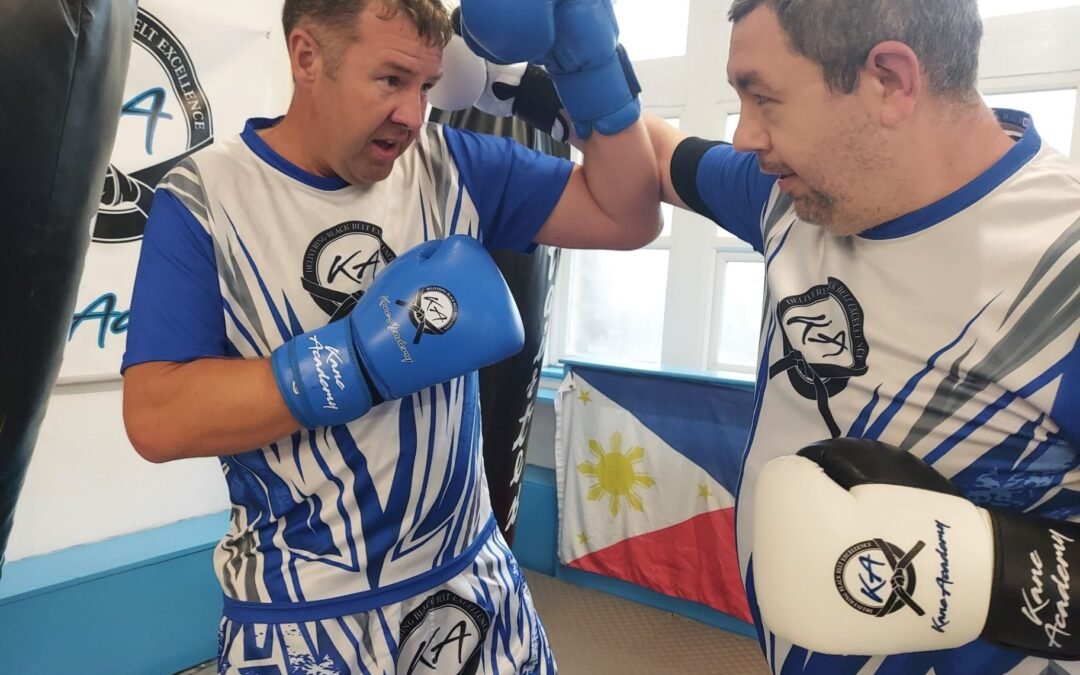
If your knees feel stiff, your back has caused problems in the past, or your confidence has taken a knock, walking into a kickboxing class may feel like a big step.
You may be wondering:
- “Am I too old to start?”
- “What if I cannot keep up?”
- “Will kickboxing make my knee or back worse?”
- “What if everyone else is already experienced?”
- “Do I need to be fit before I begin?”
The reassuring answer is that you do not need to arrive as an athlete. You need a safe starting point, patient coaching and a willingness to take one step at a time.
At Kane Academy, our dedicated over-40s kickboxing programme welcomes both men and women. Training is scaled progressively, with personal development, healthy living, kindness and resilience at the centre of the experience.
Is kickboxing suitable if you are over 40?
Yes, kickboxing can be adapted for a wide range of ages and fitness levels. The key is not to copy the hardest movement in the room. The key is to learn good technique, control your pace and progress gradually.
Kickboxing can help you develop:
- Strength and functional movement
- Cardiovascular fitness and stamina
- Balance and coordination
- Mobility and body awareness
- Stress relief and confidence
- A sense of achievement and community
You do not have to train like a world champion. Kane Academy was founded and is led by Rebecca Kane, a six-time world champion in combat martial arts, but beginners are never expected to perform at a world-champion level. Rebecca and the qualified martial arts teachers at the academy understand that every student begins from a different place.
Some people want to improve their fitness. Others want to learn practical martial arts skills, regain confidence or find a welcoming activity after years away from exercise. Your goal is valid.

What if you have sore knees?
Knee concerns are common, especially if you have experienced arthritis, previous injuries, weakness or stiffness. That does not automatically mean kickboxing is unsuitable, but it does mean that your training should be adjusted intelligently.
Start with controlled movement
Begin with a comfortable range of movement rather than trying to kick high or move quickly. Your coach can help you focus on stance, balance, hand techniques and controlled lower-body movements.
This helps you build strength and coordination without placing unnecessary demands on the joint.
Avoid forcing depth or impact
You do not need to jump, squat deeply or perform powerful kicks on your first day. Movements can be reduced in height, range and speed while you learn how your body responds.
By building control first, you give your muscles and joints time to adapt.
Communicate early
Tell your instructor about your knee before the session begins. Do not wait until the discomfort becomes severe. Clear communication allows your coach to provide suitable alternatives and monitor your technique.
Remember that mild effort and muscular fatigue are not the same as sharp or persistent pain. Stop if something feels sharp, unusual or continues after you have changed the movement.
What if your back feels stiff or vulnerable?
A history of back pain can make exercise feel intimidating. However, avoiding all movement can sometimes leave you feeling even stiffer and less confident.
Kickboxing training can include posture, stance, controlled rotation, footwork and core engagement. These elements can be introduced progressively, without asking you to twist aggressively or move beyond your comfortable range.
Focus on these principles:
-
Keep your movements controlled.
Smooth technique is more valuable than speed or power when you are starting. -
Maintain a comfortable stance.
You should be able to balance and breathe without feeling forced into an awkward position. -
Build your fitness gradually.
Take breaks when needed and return to the next exercise when you feel ready. -
Tell your instructor about previous injuries.
This gives your coach the information needed to scale the session responsibly.
Your first goal is not to complete every repetition. Your first goal is to learn how your body moves and leave feeling encouraged to return.

What happens when you are nervous about joining?
Feeling nervous is normal. Many adults worry that they will look inexperienced, forget the combinations or struggle with the warm-up.
The reality is that every experienced student was once a beginner. You are not expected to know the terminology, remember every movement or feel confident immediately.
At Kane Academy, training is built around personal development rather than comparison. You can focus on your own progress, whether that means remembering a new combination, improving your balance or simply completing a session you once felt too nervous to attend.
Try these practical steps:
- Book a trial session first. Every new member can book a trial, giving you the opportunity to experience the environment before committing.
- Arrive a little early. This gives you time to introduce yourself and explain that you are new or returning after a break.
- Wear comfortable clothing. You do not need specialist equipment for your first session.
- Set a small target. Aim to learn one technique, complete the warm-up or stay for the full session.
- Measure consistency, not perfection. Progress comes from returning regularly, not from doing everything perfectly on day one.
Confidence grows through evidence. Each time you attend, learn something new and manage a challenge, you prove to yourself that you are capable of more than you thought.
What does the research say?
A 12-week group kickboxing study involving community-dwelling adults aged 50–85 reported improvements in measures including handgrip strength and walking speed. The study did not show an increase in muscle mass, and it had important limitations: most participants were women and the programme took place in a specific research setting.
The findings should not be treated as a guarantee or a substitute for individual medical advice. However, they support a useful message: appropriately scaled, progressive kickboxing can help older adults develop aspects of strength and physical function.
You can read the full published study on group kickboxing for adults aged 50–85.
How to start safely
Before beginning, speak to your GP if you have an existing heart condition, uncontrolled blood pressure or significant joint problems. Your doctor can advise whether you need any specific precautions.
During training:
-
Tell your instructor that you are new or returning after a break.
This ensures your starting point is understood. -
Begin below your maximum effort.
Leave enough energy to maintain good technique and control. -
Use rest periods sensibly.
Taking a break is a positive training decision, not a failure. -
Stop if something feels sharp or persistent.
Do not try to push through pain that feels unusual or does not settle. -
Progress one variable at a time.
Increase duration, speed, range or intensity gradually rather than changing everything at once.
Good coaching should make you feel challenged, supported and listened to.
Current Kane Academy class times
Kane Academy runs family-friendly martial arts programmes for everyone from age four to adults, including Tiny Tigers, Ninja Kids, teenage and adult kickboxing, women’s kickboxing, women’s self-defence and over-40s kickboxing for both men and women.
The currently confirmed general class times include:
- Tuesday: Teen & Adult Kickboxing, 7:15–8:00pm
- Thursday: Teen & Adult Kickboxing, 7:15–8:00pm
- Saturday: Family Kickboxing, 12:15–1:00pm
The dedicated over-40s sessions are not currently shown on the published timetable, so please check the full Kane Academy timetable and contact the academy to confirm the latest over-40s session times.
Kane Academy trains at Holy Trinity Church Hall, St James’s Road, Marsh, Huddersfield, HD1 4QA. You can use the contact page to ask about availability and book your trial.
Choose the right first step for you
Every new member can start with a trial session. If you decide to continue, Kane Academy also offers:
- A 4-week starter programme for £49.99
- A 6-week beginner course for £199, including uniform, gloves and gradings
These options give you structure while you learn the foundations and become familiar with the academy community.

Your age is not a barrier
Your knees, back or confidence may be telling you to be cautious. They do not have to tell you to stop.
With qualified coaching, sensible modifications and consistent practice, you can begin from your current ability and build from there. You do not need to be flexible, powerful or highly fit before your first session. You simply need a supportive environment that respects your starting point.
Kane Academy is a female-led martial arts academy with experienced instructors and strong community values. If you are looking for martial arts in Huddersfield, West Yorkshire or Kirklees, the best martial arts school for you should be one where you feel welcomed, coached and encouraged to grow.
Book your trial, ask your questions and take the first step towards unleashing your inner warrior. Your next chapter can begin at any age.