
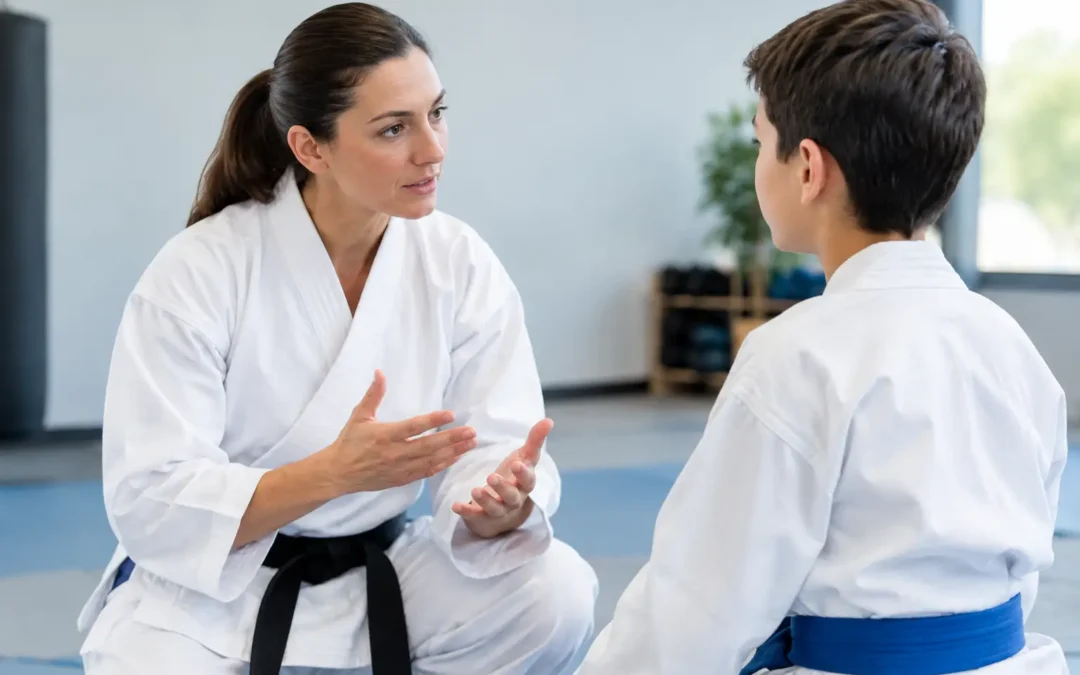
A coach calls, “Guard up.” A child who was chatting a moment earlier settles their feet, lifts their hands and looks forward. That small change is one reason parents ask, does martial arts improve listening? In a well-run class, listening is not a separate worksheet or lecture. It is a practical skill that members use repeatedly – to stay safe, learn a technique, work with a partner and make progress.
Martial arts cannot magically turn every child, teenager or adult into a perfect listener. Personalities, needs, tiredness and confidence all play a part. But structured training can create regular, meaningful opportunities to practise listening, responding and refocusing. Over time, that practice can make a real difference both on and off the mats.
Does martial arts improve listening in children?
For many children, listening improves when there is a clear reason to pay attention. A martial arts class gives instructions an immediate purpose. If they listen carefully, they know where to stand, which hand to use, when to move and how to practise safely with others.
This is especially helpful because good listening is more than being quiet. It involves looking towards the speaker, processing what has been said, remembering the steps and responding appropriately. In a children’s class, those skills are rehearsed again and again through warm-ups, drills, games, partner work and grading preparation.
A young member might be asked to copy a short sequence: stance, guard, step, punch. At first, they may need each instruction broken down and repeated. With patient coaching and consistent routines, they begin to hold more information in mind. They learn that waiting for the full instruction often leads to better results than rushing ahead.
That carries a valuable lesson beyond training: pause, pay attention, then act. For parents who hear that their child struggles to follow directions at home or school, martial arts can offer another positive setting in which to build that habit.
Clear routines reduce the guesswork
Children often listen better when they know what is expected. A structured martial arts lesson has a rhythm: arrive, line up, warm up, learn, practise, cool down and finish with respect. The routine does not make classes dull. It gives children a secure framework, so they can spend less energy working out what happens next and more energy focusing on the task.
The language used by instructors matters too. Short, clear instructions work particularly well for younger children. A coach may demonstrate first, give one or two cues, then allow the class to try. Feedback is specific: “Great listening, you waited for the signal,” rather than a vague “good job”. Children learn exactly what listening looks like in action.
This approach can be particularly supportive for children with additional needs, although every child is different. Some may benefit from visual demonstrations, extra processing time, smaller steps or a calmer reminder. Inclusion is not about expecting everyone to learn in the same way. It is about creating a safe environment where each member can build skills at a pace that is right for them.
Why martial arts listening skills matter for safety
Listening in martial arts is not just about good behaviour. It is part of training safely and respectfully. Members need to hear when to begin and stop, understand how much contact is appropriate, follow rules around equipment and respond to their partner’s movements.
That shared responsibility helps children understand that their choices affect other people. If one person does not listen, a drill can become confusing or unsafe. If everyone listens, the class can train with control, confidence and trust.
This is one of the strongest differences between simply being active and learning a martial art. Fitness is an excellent benefit, but martial arts asks members to connect physical movement with awareness and self-control. A powerful technique without control is not the goal. The goal is a capable person who can follow instruction, respect boundaries and use their skills responsibly.
For teenagers and adults, the same principle applies. Listening closely during kickboxing or self-defence training means understanding technique, managing intensity and training intelligently. It can also be a welcome reset after a busy day, when concentration has been pulled in too many directions.
Listening builds confidence, not compliance
There is a misconception that listening means unquestioning obedience. Healthy martial arts teaching should aim higher than that. It should help members become confident listeners who can take in information, ask sensible questions and make responsible decisions.
A shy child may initially avoid eye contact, stay at the back or worry about getting an answer wrong. As they become familiar with the class, they often find that listening gives them a route into participation. They hear the instruction, understand the next step and complete it successfully. That success builds confidence.
The same pattern can help a teenager who feels distracted or an adult beginner who worries they are not naturally coordinated. Nobody needs to know everything on day one. They need a welcoming place, a qualified instructor and a clear next instruction. Progress comes from showing up, listening and having another go.
At Kane Academy, that progression is central to the experience. Members are encouraged to work hard while being supported as individuals. The aim is not to create silent classes. It is to build focused, respectful people who feel able to speak up, learn and grow.
The role of discipline and positive reinforcement
Discipline works best when it is consistent, fair and linked to a positive purpose. Children respond well when they understand why a rule exists. “Listen because it keeps your partner safe” is far more meaningful than “listen because I said so”.
Praise also has a role, but it should recognise effort and improvement rather than demand perfection. A child who struggled to settle at the start of a lesson but refocused after a reminder has made progress. Noticing that effort helps them connect self-control with pride.
Over time, members may become better at recognising their own state too. They learn to notice when they are distracted, frustrated or overexcited, then return attention to the coach or task. That ability to reset is useful at school, at work and at home.
What martial arts can and cannot do
Martial arts can support better listening, but it is not a replacement for professional advice where a child has significant communication, attention or sensory needs. Families should always seek appropriate support when they are concerned about development or wellbeing.
It is also worth being realistic about timescales. Some children show a change quickly because they enjoy the new structure and social setting. Others need weeks or months of steady attendance before routines start to feel familiar. A difficult day does not mean training is failing. Everyone has days when focus is harder.
The quality of the class matters greatly. Look for age-appropriate teaching, clear boundaries, patient instructors and a culture where children are treated with kindness. A loud, intimidating environment may make some people shut down rather than listen. The best learning happens when members feel safe enough to concentrate and challenged enough to stay engaged.
Parents can reinforce the connection at home without turning it into pressure. After class, try asking, “What was one instruction you remembered today?” or “When did you show good focus?” These questions help children notice their own progress. They also make room for a conversation about persistence when something felt difficult.
A skill that grows one lesson at a time
Listening is rarely transformed by one big speech. It grows through hundreds of small moments: standing still while a drill is explained, hearing a correction, waiting for a partner, trying again and celebrating a skill that finally clicks.
For children, teenagers and adults, martial arts offers a practical place to practise that process. The result is not just better attention in class, but greater self-awareness, respect and confidence in everyday life. Start with a supportive lesson, give progress time, and let each focused moment become part of something bigger.