
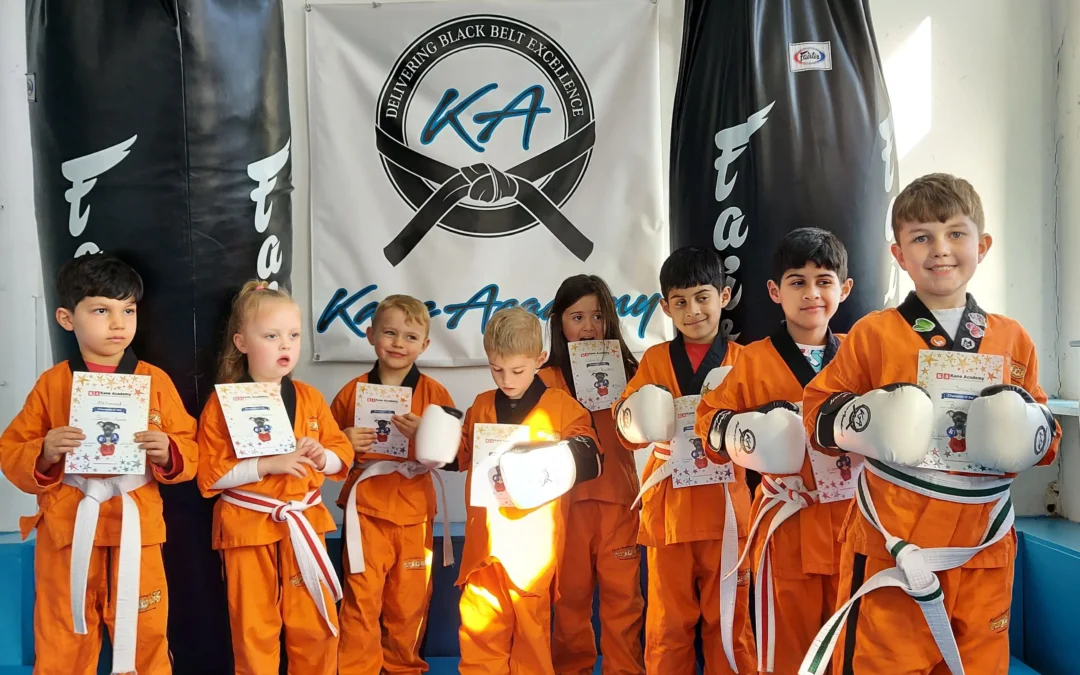
If you have two children close in age, you may already know how it starts: the second one wants to do whatever the first one does. That can be a lovely way into a new activity, but it needs a little thought so training does not become one child measuring themselves against the other.
We see plenty of brothers and sisters on the mats at our martial arts classes in Huddersfield. It works best when a few simple things are set up right from the beginning. Here is a practical guide to helping two or three children train in a way that gives each one room to grow.
1. Let the younger one copy, then give them their own class
An older sibling can make a new activity feel familiar. Research into children’s physical activity also points to siblings as potential role models and influences on each other’s participation. Seeing a brother or sister take part can help make starting feel less daunting.
At Kane Academy, children are placed according to age, not according to who joined first or who has more experience. For example, a 6-year-old attends Tiny Tigers and a 9-year-old attends Ninja Kids, even if the younger child has been training longer.
Our junior pathways include:
- Tiny Tigers: ages 4 to 7
- Ninja Kids: ages 7 to 12
- Black Belt Club Elite and Teen and Adult classes: for older members
The age bands give children a suitable group and learning environment. Let the younger sibling be inspired by the older one, then encourage them to make their own connections and progress in their class.
2. Give each child their own progress, not a shared scoreboard
Gradings and belts are individual. One sibling may be ready to grade before the other, or the younger child may catch up. That is part of learning at different paces, not a verdict on who is better.
At home, be specific about what you noticed. Try “Your focus in the last round was brilliant” rather than “You’re ahead of your brother.” Praise effort, listening, persistence and a skill the child has worked on. This helps each child connect achievement with their own choices, rather than with their sibling’s results.
In our experience, this is the single biggest thing that decides whether siblings both stay in it: each child needs to feel that their journey belongs to them.
3. Keep one thing that is just theirs
Training together does not mean children need to share every part of the experience. Some children need something, even a small thing, that feels like their own.
Give them space to talk about what they enjoy separately. If one child seems to be living in the other’s shadow, tell the instructor. We can arrange pairs and partners thoughtfully, so both children get the chance to participate in their own way.
4. Handle the drop-out question before it happens
What if one child loves martial arts and the other does not? It is worth deciding now that you will listen to each child as an individual.
Do not make one child continue simply to keep the family routine tidy. Equally, do not pull the child who loves training out just because it seems easier to have them both at home. A trial session is there precisely so a new member can find out whether they like it. It is better to try it early, before signing up, than to commit and then stop because the activity was not the right fit.
5. One trip, two classes, no extra evenings
Family timetables are already busy, so combining activities into one visit can make a real difference. On Tuesdays and Thursdays, Tiny Tigers and Ninja Kids run back to back from 4:00pm to 6:30pm. That means children in different programmes can often train during the same visit. On Saturday morning, junior classes run from 9:00am to 11:30am, so you can get training done before lunch.
There is also Women’s Kickboxing at 11:30am on Saturday and Family Kickboxing at 12:15pm for parents who want to join in with their children. Check the exact class options below, and view the full timetable before planning your visit.
6. What siblings actually give each other on the mats
A familiar face in the room can make the first day easier. Siblings may also have someone to practise with at home, a shared language around respect and effort, and a reason to keep going on a cold evening. Kindness and resilience become things children practise, not just values they hear about.
There is a harder side, too. Siblings can wind each other up, and rivalry is normal. Hoping it will settle on its own is not always the answer. Let the coach know what you are seeing, so we can respond early and pair or separate children deliberately when that will help.
What the research says
A 2018 systematic review and meta-analysis in BMJ Open Sport & Exercise Medicine included 19 studies of children aged 2 to 18. Its pooled analysis found that children with siblings had higher levels of moderate-to-vigorous physical activity than only children, with a possible pattern of more activity as the number of siblings increased. The authors suggested that siblings may act as peer models, encourage sports participation and be playmates or supervisors.
The same literature notes that rivalry and mismatched skill levels can work the other way. This is general research into children and physical activity, not a promise about what will happen in our classes. The practical takeaway is that sibling influence can help, but it is not automatic. A supportive coaching environment matters. Read the review.

Your child does not need a sibling to belong
If you are an only child, or you are one of several siblings yourself, the same encouragement can come from a cousin, a friend or a teammate. Our classes bring together children who are not related, so every child has the chance to meet training partners and become part of the group.
Class timetable
Here are the confirmed class times for the junior programmes and other relevant Saturday sessions. For the complete schedule, view the full Kane Academy timetable.
Tuesday and Thursday
- 4:00–4:30pm: Tiny Tigers
- 4:30–5:00pm: Tiny Tigers
- 5:00–5:45pm: Ninja Kids
- 5:45–6:30pm: Ninja Kids
- 6:30–7:15pm: Black Belt Club Elite Class
- 7:15–8:00pm: Teen and Adult Kickboxing
Saturday
- 9:00–9:30am: Tiny Tigers
- 9:30–10:00am: Tiny Tigers
- 10:00–10:45am: Ninja Kids
- 10:45–11:30am: Ninja Kids
- 11:30am–12:15pm: Women’s Kickboxing
- 12:15–1:00pm: Family Kickboxing
Practical details for Huddersfield families
Kane Academy is at St James Hall, St James Road, Marsh, Huddersfield, HD1 4QA, convenient for families travelling from Marsh, Lindley, Salendine Nook, Oakes, Fixby and Greenhead, and from across Kirklees and West Yorkshire.
- The four-week starter programme is £49.99.
- The six-week beginner course is £199, including uniform, gloves and gradings.
- Trial sessions are available for all new members.
- Classes benefit from world champion instruction from Rebecca Kane, alongside female instructors in the team. Read more about Rebecca and the academy.
Whether you are exploring martial arts in Huddersfield for the first time or looking for kickboxing in Huddersfield that fits around two children’s activities, the right starting point is a chance to try it. Book a trial session for each child, and contact us when you book to ask whether they can attend the same visit. Both children can see the room, meet the instructor and decide whether they enjoy it before you commit.
Give each child their own path, while letting them encourage one another along the way. With steady support, they can build confidence, discipline and respect, together and as individuals.