
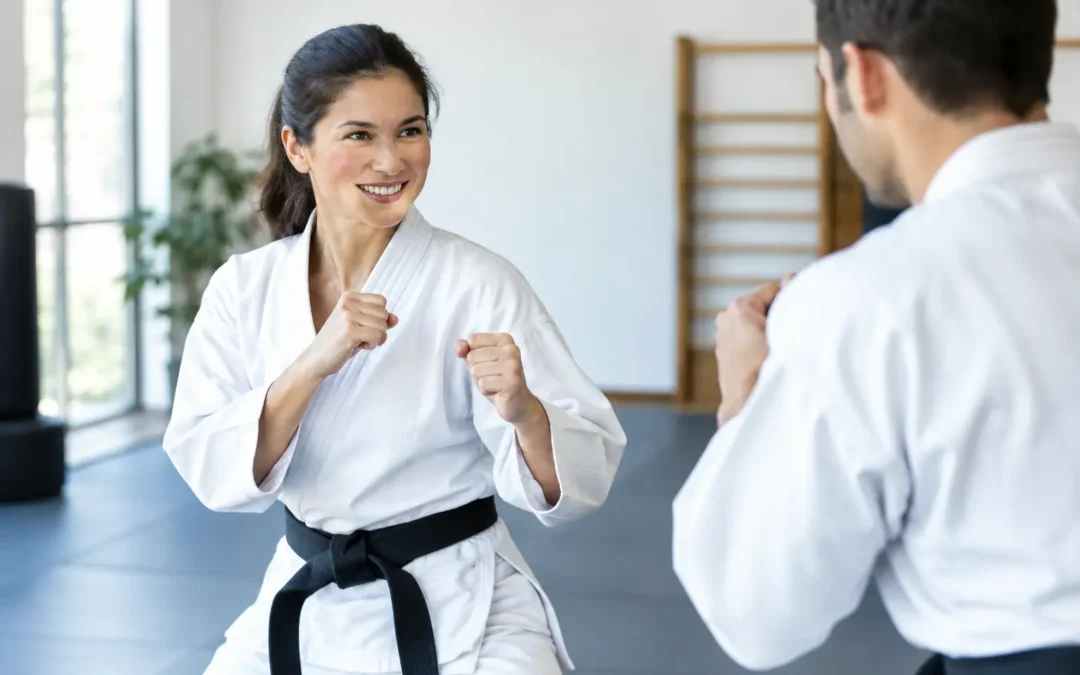
Walking into your first martial arts class can feel more daunting than the workout itself. You may be wondering whether everyone else will be fitter, younger or already know what they are doing. The reality is that how adults start martial arts safely has far less to do with natural talent and far more to do with finding the right coaching, listening to your body and giving yourself permission to be a beginner.
Martial arts training should challenge you, not frighten you. A well-run beginner class gives adults the chance to build fitness, learn practical self-defence skills and release the pressure of a busy week, all within a structured and supportive environment. You do not need to arrive flexible, strong or confident. You simply need a sensible starting point.
Choose a beginner-friendly class, not the toughest-looking one
Your first decision matters because martial arts are not all taught in the same way. Some classes focus heavily on competition, others on fitness, traditional forms, self-defence or technical development. None of these approaches is automatically better, but the right one depends on what you want from training.
If your goal is to get fitter while learning useful striking and self-defence skills, an adult kickboxing programme with a clear beginner pathway can be a great fit. If you are interested in awareness, practical responses and personal safety, self-defence training may be a priority. Filipino martial arts can appeal to adults who enjoy learning coordination, movement and weapon-awareness concepts in a controlled setting.
Look for a class that clearly welcomes complete beginners and explains how people progress. You should not be expected to copy advanced students without guidance or be thrown into hard sparring on your first session. Professional coaching means breaking techniques into manageable stages, correcting movement early and creating a culture where questions are encouraged.
For adults in Huddersfield, a trial session or introductory course is a useful way to assess the atmosphere before committing. Notice whether the instructors know how to adapt drills for different fitness levels, whether members support one another and whether safety rules are taken seriously. The best class will make you feel challenged and included at the same time.
How adults start martial arts safely: begin at your own pace
One of the most common beginner mistakes is trying to prove too much in week one. It is understandable. A new class can bring a burst of motivation, and you may want to keep up with the person who has been training for two years. But confidence grows faster when you train consistently than when you push so hard that you need several weeks to recover.
Start with controlled effort. Focus on your stance, balance, breathing and the basic mechanics of each technique before worrying about power or speed. A clean punch delivered with good posture is safer and more useful than a wild punch thrown at full force. The same applies to kicks: height is less important than balance, control and a safe return to stance.
Tell your instructor about any previous injuries, ongoing medical conditions or concerns before class begins. This is not an admission of weakness. It gives your coach the information needed to offer appropriate adjustments. A knee issue may mean changing the range of a kick. A sore shoulder may mean reducing volume on certain punches. Pregnancy, recent surgery or a long period away from exercise may require advice from a healthcare professional before you begin.
Expect some muscle soreness when you start, particularly in your legs, core and shoulders. Sharp pain, swelling, dizziness or pain that changes the way you move are different signals. Stop, tell your instructor and do not try to train through them. Learning to recognise the difference between normal effort and a warning sign is part of becoming a capable martial artist.
Build frequency before intensity
For most new adults, one or two sessions a week is enough to make real progress. It allows your body to adapt while helping you create a routine that works around work, family and other commitments. Training three or four times a week may become realistic later, but there is no prize for rushing there.
Between classes, walking, gentle mobility work and good sleep will support recovery. You do not need an extreme diet or a punishing gym plan to earn your place on the mats. Consistency, hydration and regular meals will take you much further than an all-or-nothing approach.
Learn the safety habits that protect everyone
Martial arts are built on respect. That includes respect for your training partner’s safety as much as your own. Even when drills look fast or energetic, responsible training relies on communication and control.
Listen closely when techniques are explained, especially during partner work. Ask where a strike should land on pads, how much contact is appropriate and when to stop. If you are uncertain, slow down. Speed can be developed over time; poor habits are much harder to undo.
Good protective equipment matters when the activity calls for it. Your instructor should explain what you need and when you need it, whether that is gloves, hand wraps, shin guards or other suitable kit. Equipment reduces risk, but it never replaces control. A powerful technique should only be used at the level the drill requires.
It also helps to choose training clothes that allow you to move comfortably and safely. Remove jewellery, tie back long hair and keep fingernails short for partner drills. Arrive a few minutes early so you are not rushing into class flustered and cold. A gradual warm-up is there for a reason: it prepares your body and your focus for the session ahead.
Do not let embarrassment stop you from asking questions
Adults often bring a particular fear to their first class: looking foolish. Children tend to ask immediately when they do not understand something. Adults can spend ten minutes pretending they know which foot goes where. That hesitation can make a simple drill feel harder than it is.
Ask the question. Request a demonstration again. Tell your instructor if a movement does not feel right. Good coaching is not about making you feel behind. It is about helping you understand the next step clearly enough to improve.
This becomes especially valuable in self-defence training. Practical self-defence is not about memorising a dramatic move or believing you can handle every situation physically. It is about awareness, boundaries, decision-making and learning age-appropriate, realistic actions under professional guidance. A quality programme will never encourage reckless behaviour or present violence as the first answer.
Set goals that are bigger than the scales
Many adults first consider martial arts because they want to lose weight or improve fitness. Those are valid goals, and regular kickboxing training can improve cardiovascular fitness, strength, coordination and mobility. Yet the benefits people notice most often are sometimes less visible.
You may find that you stand taller in meetings, cope better with stressful days or feel more comfortable taking up space. You might enjoy earning a new belt or certificate, learning a combination that once felt impossible, or becoming the person who turns up even when life feels busy. These are meaningful signs of progress.
Set a simple first goal: attend regularly for a month, learn the names of a few core techniques or complete an introductory course. Keep it achievable. As your skills grow, you can decide whether you want to work towards gradings, improve your fitness, train for self-defence confidence or explore a new discipline more deeply.
Find a community that keeps you coming back
The safest start is not just physical. It is emotional too. Adults are more likely to stick with training when they feel recognised, respected and encouraged by the people around them.
A strong martial arts community has room for different starting points. Some people will be returning to exercise after years away. Others will be experienced gym-goers who want a new challenge. Some will want a powerful stress release after work; others will be looking for confidence after a difficult period. Everyone deserves patient coaching and a place to progress.
At Kane Academy, adult training is designed to combine credible martial arts instruction with the confidence, discipline and resilience that carry into everyday life. You are not expected to be an elite athlete before you begin. You are expected to show up, stay open to learning and treat yourself and others with respect.
Your first class does not need to be perfect. Put on comfortable kit, arrive with an open mind and focus on one technique at a time. A safe start is not about avoiding challenge – it is about choosing the right challenge, with the right support, then returning next week a little stronger than before.