
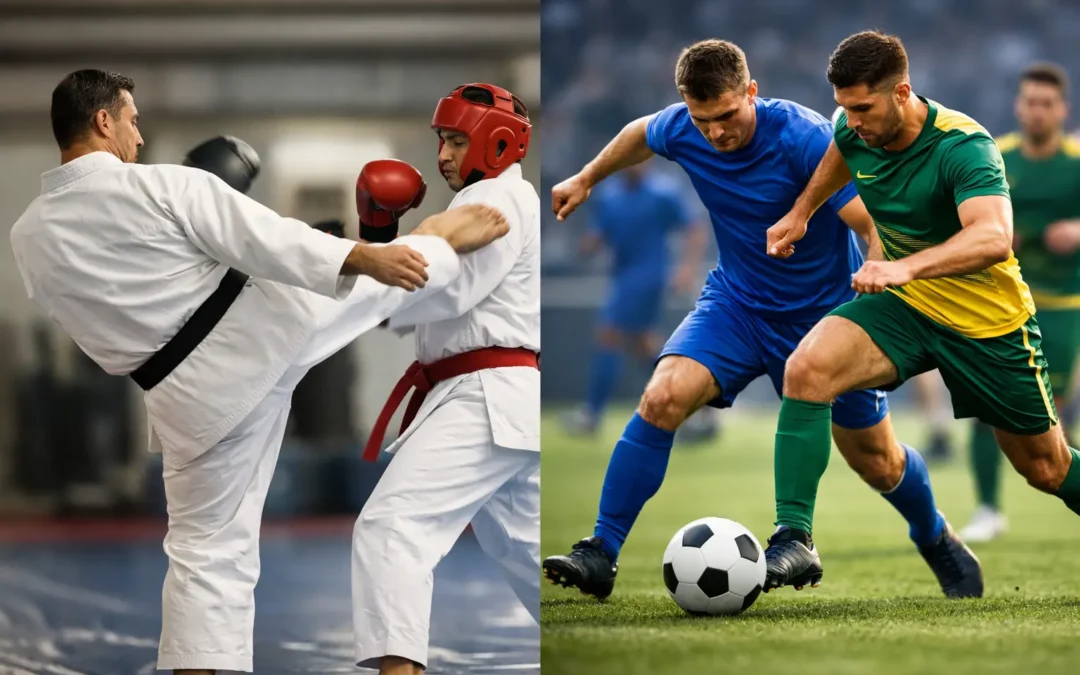
A child is standing at the side of a football pitch, unsure whether to join in. Another is tying their belt before class, ready to practise alongside people their own age. When parents weigh up martial arts versus team sports, the best choice is rarely about which activity is ‘better’. It is about finding the setting where a child, teenager or adult feels motivated to keep turning up, trying and growing.
Team sports can bring brilliant friendships, shared excitement and a strong sense of belonging. Martial arts offer many of those same social benefits, while giving each student a personal path forwards. For families who want structured fitness, confidence and practical self-defence skills, that difference can be powerful.
Martial arts versus team sports: the key difference
The biggest distinction is how progress is measured. In most team sports, the group works towards one result: winning the match, moving up a league or performing well as a squad. Every player matters, but playing time and responsibility can vary according to age, experience and the needs of that particular game.
In martial arts, students train together but progress as individuals. A beginner can stand beside someone more experienced and still have a clear job to do: improve their stance, learn a combination, build fitness or prepare for their next grading. There is no bench to sit on and no need to be the fastest person in the room to feel successful.
That does not make martial arts a solitary activity. A good class depends on training partners, encouragement, respect and shared standards. Students hold pads, practise drills safely and celebrate each other’s achievements. The difference is that their confidence is not dependent on the score at full time.
Confidence that does not depend on being picked
For a shy child, joining a large team can be a big leap. There may be unfamiliar rules, fast-moving games and the worry of making a mistake in front of everyone. Some children thrive on that energy. Others need a more structured route into participation.
Martial arts classes provide repeated, manageable challenges. Students learn how to line up, listen, follow instructions, work with a partner and speak up when needed. As techniques become familiar, they see a direct connection between effort and improvement. A stronger guard, better balance or a newly earned belt gives them evidence that they can do difficult things.
This is especially valuable for children who do not see themselves as sporty. They do not have to arrive already confident, flexible or coordinated. They can start as beginners and make progress at their own pace within a supportive group.
For teenagers, that individual focus can be a welcome antidote to comparison. Training gives them a positive outlet for energy and stress, as well as goals that are under their control. Adults benefit too. Rather than hoping to be selected for a side, they can train towards better fitness, sharper technique and a genuine sense of achievement.
Fitness: different routes to a healthier routine
Team sports often develop endurance, speed, coordination and tactical awareness. Regular football, rugby, netball or hockey sessions can make exercise feel like play, particularly for people who love competition and live for match day.
Kickboxing and martial arts build fitness in a different way. Students work on cardiovascular conditioning, mobility, balance, coordination, core strength and controlled power. Drills may be energetic, but technique matters. Learning to move well and strike pads correctly asks the body and mind to work together.
For many people, the main advantage is consistency. A weekly class has a predictable structure, whatever the weather and whatever the league table says. There is always something useful to practise, whether that is a basic stance in a children’s class or a demanding pad-work round for an adult.
Of course, neither option removes the need for good coaching, suitable equipment and sensible progression. Young children should not be pushed through adult-style training, and beginners of any age should be given time to build confidence safely. The right class makes training challenging without making it intimidating.
Friendship and belonging still matter
A common concern is that martial arts cannot provide the friendships associated with a team. In reality, a welcoming academy can become a strong community. Students see familiar faces each week, encourage one another through drills and share the excitement of gradings, competitions or personal milestones.
The friendships can feel different from those built in a conventional team. There is less pressure to fit one narrow role, such as striker, goalkeeper or defender. A quiet child can belong without having to dominate the conversation. A teenager can work hard with others without feeling that one missed chance has let everyone down.
That said, some children genuinely love the buzz of a squad. They enjoy tactics, shared wins and the rhythm of a weekend fixture. If they come home talking excitedly about their team, team sport may be exactly right for them. The goal is not to steer every child away from the pitch or court. It is to recognise that there is more than one excellent way to become active and connected.
Resilience without fear of failure
Both martial arts and team sports teach resilience, but they place children in different kinds of pressure. A team player learns to recover after a loss, accept decisions and support teammates when things do not go to plan. Those are valuable life skills.
Martial arts teach students to recover from smaller setbacks week after week. Perhaps a technique feels awkward. Perhaps they need extra practice before a grading. Perhaps a training partner is more experienced. With patient coaching, those moments become normal parts of learning rather than reasons to quit.
The belt system can help make progress visible. It gives students a longer-term goal while reminding them that advancement is earned through regular effort, good attitude and improving skill. A belt is not simply a reward for attendance. It represents responsibility as well as achievement.
For parents, this can be particularly reassuring. Martial arts can reinforce clear expectations around listening, respect, self-control and kindness. The strongest programmes do not glorify fighting. They teach students when to use calm communication, how to avoid unnecessary conflict and why physical skills must be handled responsibly.
Self-defence is a practical extra
Team sports can improve awareness, confidence and physical capability, but they are not designed to teach self-defence. Martial arts training can offer an additional real-world benefit: knowing how to create space, stay calm and respond more effectively if a situation becomes unsafe.
For children, self-defence starts well before any physical technique. It includes awareness, boundaries, using a confident voice and telling a trusted adult. For women, teenagers and adults, training can build reassurance through practical movement and controlled scenarios, always taught in a safe, respectful environment.
This does not mean martial arts students become invincible, nor should training create fear. The purpose is empowerment. Students learn that avoiding danger and de-escalating a situation are far better outcomes than proving anything physically.
How to choose the right activity
Start with your child’s personality and what you hope the activity will provide. A confident child who loves competition may flourish in a team. A child who needs structure, individual recognition or a confidence boost may find their feet faster in martial arts. Many families find that their child enjoys both at different stages.
Try not to choose only by convenience or what friends are doing. Watch a session if you can. Look for qualified, attentive coaches, clear boundaries, age-appropriate teaching and a culture where beginners are welcomed. Ask whether every participant is involved, how progress is recognised and what support is available for children with additional needs.
At Kane Academy, age-specific classes give Tiny Tigers, Ninja Kids, teenagers and adults room to develop at the right pace. A trial class can also take the pressure out of the decision. One session often tells you more than weeks of debating at home.
The right activity is the one that leaves your child standing a little taller as they walk out of class. Give them a safe chance to try, and let their growing confidence help guide the next step.