
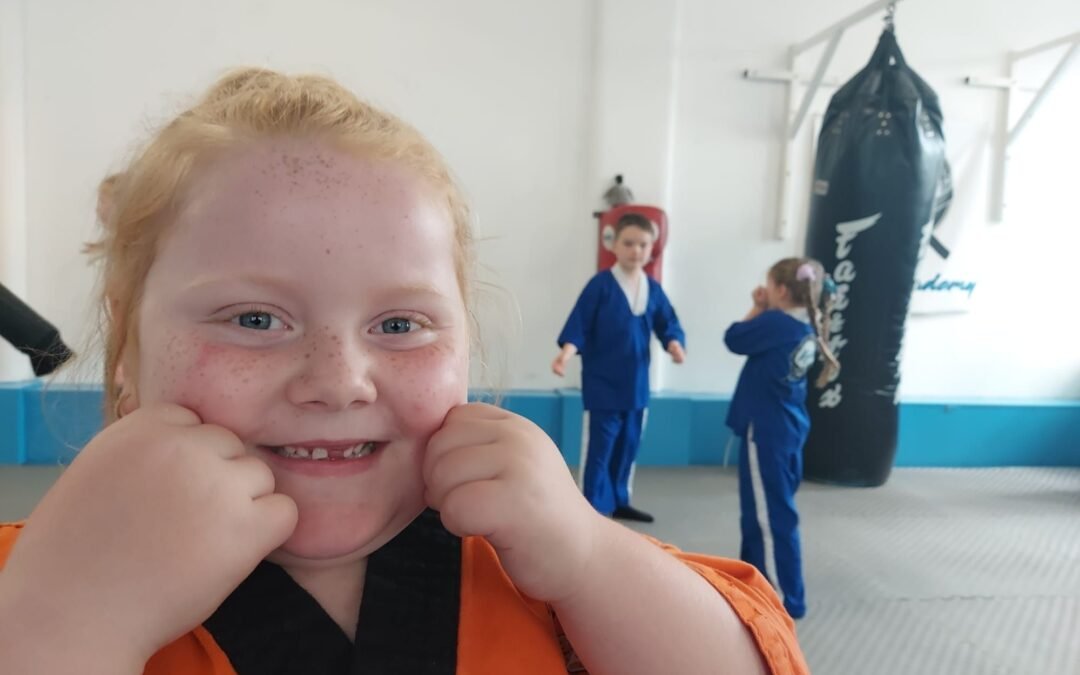
Starting martial arts can feel exciting, challenging and slightly outside your comfort zone. You may wonder whether you are fit enough, coordinated enough or confident enough to begin.
The truth is that you do not need to arrive as a fighter. You simply need to arrive ready to learn.
Kane Academy’s 10-week beginner course is designed to help you build confidence, discipline and respect step by step. For £199, your course includes your uniform, gloves and grading, giving you everything you need to begin your martial arts journey with clear goals and expert support.
The experience is suitable for families and individuals across our programmes, from Tiny Tigers aged 4–7 and Ninja Kids aged 7–12 to teenagers, adults, women and over-40s students. Every beginner starts from a different place, but everyone can make meaningful progress.
What is included in the 10-week beginner course?
Before exploring the weekly journey, it helps to understand what you are working towards. The course gives you:
- A structured introduction to martial arts and kickboxing
- Your Kane Academy uniform
- Your gloves
- Progressive coaching suitable for beginners
- A grading opportunity
- A welcoming community focused on personal development
You will learn practical techniques, improve your fitness and develop habits that extend beyond the academy. You will also discover that progress is not only measured by how hard you can kick or punch. It is measured by how consistently you show up, how well you listen, how respectfully you train and how confidently you handle challenges.

Weeks 1–2: Turning nerves into your first achievement
The first two weeks are about becoming comfortable in a new environment. You will meet your instructors, learn how the sessions work and begin practising the foundations of martial arts.
Depending on your age and programme, this may include:
- Stance and balance
- Basic footwork
- Simple punches and kicks
- Safe movement
- Listening and following instructions
- Warm-ups, mobility and beginner fitness drills
For younger students, lessons are taught in an age-appropriate and engaging way. Tiny Tigers learn through fun activities that develop coordination, balance and listening skills. Ninja Kids begin building focus, resilience and self-belief. Teenagers and adults can expect structured kickboxing training in a friendly, supportive environment.
It is normal to feel nervous at the beginning. You may not remember every technique immediately, and that is completely fine. Your first achievement may simply be walking through the door, taking part in the full class or trying something that initially felt difficult.
Focus on participation rather than perfection. By doing so, you give yourself permission to learn and begin building genuine confidence.
Weeks 3–4: Learning the foundations
By weeks three and four, the training begins to feel more familiar. You will start connecting individual movements into simple combinations and may spend more time working with pads or a training partner.
You may practise:
- Basic punch combinations – This helps you develop timing, coordination and accuracy.
- Front kicks and controlled kicking techniques – These build balance, mobility and lower-body strength.
- Pad work – This gives you a clear target and makes your progress easy to feel.
- Defensive movements – These introduce awareness, guard position and safe movement.
- Fitness rounds – These gradually improve stamina and recovery.
This is often when beginners notice their first physical changes. You may recover more quickly between rounds, feel stronger during everyday activities or find that your coordination is improving.
You may also notice a change in your mindset. Movements that felt unfamiliar in week one begin to feel more natural. You start to understand that confidence is not something you have to wait for. It grows when you practise, receive feedback and see yourself improving.

Weeks 5–6: Building fitness, focus and resilience
The middle of the course is where consistency becomes especially important. The sessions may feel more demanding, but you will also have a stronger foundation to work from.
You will be encouraged to:
- Maintain good technique when you become tired
- Listen carefully to coaching points
- Work respectfully with different partners
- Control your movements
- Keep going when a combination feels challenging
- Celebrate progress rather than comparing yourself with others
For children, these lessons can reinforce patience, self-control and positive behaviour. For adults, training can provide a powerful way to release stress, improve fitness and focus on something constructive.
Research into structured martial arts programmes suggests that progressive skill learning, clear rules and an emphasis on self-control can support attention and self-regulation, particularly in children. A school-based taekwondo study highlighted by the University of Surrey found improvements in children’s self-regulation compared with traditional physical education.
Every programme is different, and martial arts are not a guaranteed solution to every challenge. However, the message is encouraging: a supportive, well-structured environment can help you practise focus and persistence in a practical way.
Weeks 7–8: Applying your skills
As your confidence grows, you will begin applying techniques with more purpose. You may work through longer combinations, controlled partner drills and basic self-defence concepts appropriate to your programme.
This is not about trying to prove how tough you are. It is about learning how to stay calm, follow instructions and make good decisions while moving.
You will continue developing:
- Awareness
- Coordination
- Distance and timing
- Defensive habits
- Self-control
- Practical confidence
You may experience a plateau during these weeks. Perhaps one technique is not coming together as quickly as you hoped, or you find it difficult to remember a sequence. Treat this as part of the process, not a sign that you are failing.
Break the challenge into smaller parts. Ask for feedback, practise one section at a time and return to the basics. This helps you develop resilience, the ability to respond positively when progress is not instant.

Weeks 9–10: Preparing for your grading
The final two weeks bring your learning together. You will revisit the core techniques and practise demonstrating them with focus and control.
Your preparation may include:
- Revising your stance and movement
- Practising the required techniques
- Repeating combinations
- Improving your fitness and focus
- Listening to final corrections from your instructor
- Rehearsing under light pressure
A grading is an opportunity to demonstrate your development. It is not a test of whether you are perfect. Your instructors will consider your preparation, technique, attitude and readiness.
For a Tiny Tiger or Ninja Kid, grading can be a proud moment that shows how much they have learned. For a teenager or adult, it can be the first time they recognise themselves as a martial arts student rather than someone who is simply “trying a class”.
The biggest achievement is completing the ten weeks. The grading is a milestone within a much longer journey of continuous growth.

What changes can you expect after 10 weeks?
Everyone’s results are different, but consistent beginners often notice progress in several areas:
Confidence
You become more willing to try, make mistakes and keep learning. Completing a course gives you evidence that you can achieve something challenging.
Discipline
You develop the habit of attending, listening, practising and completing what you started. These behaviours can support your goals at home, at school, at work and in everyday life.
Fitness
Kickboxing training can improve stamina, coordination, strength and general physical activity levels when you participate regularly.
Respect
You learn to respect your instructors, training partners, the academy and your own development. Respect is shown through your actions, not simply spoken about.
Community
You train alongside people who are also learning and progressing. That shared experience can make it easier to stay motivated and enjoy the journey.
Confirmed Kane Academy class times
Our current timetable includes age-specific sessions throughout the week:
- Tiny Tigers, ages 4–7: Tuesday and Thursday at 4:00–4:30pm or 4:30–5:00pm; Saturday at 9:00–9:30am or 9:30–10:00am
- Ninja Kids, ages 7–12: Tuesday and Thursday at 5:00–5:45pm or 5:45–6:30pm; Saturday at 10:00–10:45am or 10:45–11:30am
- Teen and Adult Kickboxing, ages 13+: Tuesday and Thursday at 7:15–8:00pm
- Women’s Kickboxing, ages 12+: Saturday at 11:30am–12:15pm
- Family Kickboxing, ages 12+ welcome: Saturday at 12:15–1:00pm
Please check the full Kane Academy timetable before booking, as class availability and schedules can change.
Your next step starts with showing up
Your first ten weeks will not always feel easy: and they are not meant to. They are designed to help you grow gradually, with expert instruction, clear milestones and a community that believes in your potential.
You do not need to be the fittest person in the room. You do not need previous martial arts experience. You do not need to feel confident before you begin.
Start where you are. Learn one technique at a time. Keep returning to the mat.
With your uniform, gloves and grading included in the £199 10-week beginner course, Kane Academy gives you a clear and empowering way to begin building confidence, discipline and respect.
Discover Kane Academy classes, book an introductory course or contact the academy to take your first step and unleash your inner warrior.