
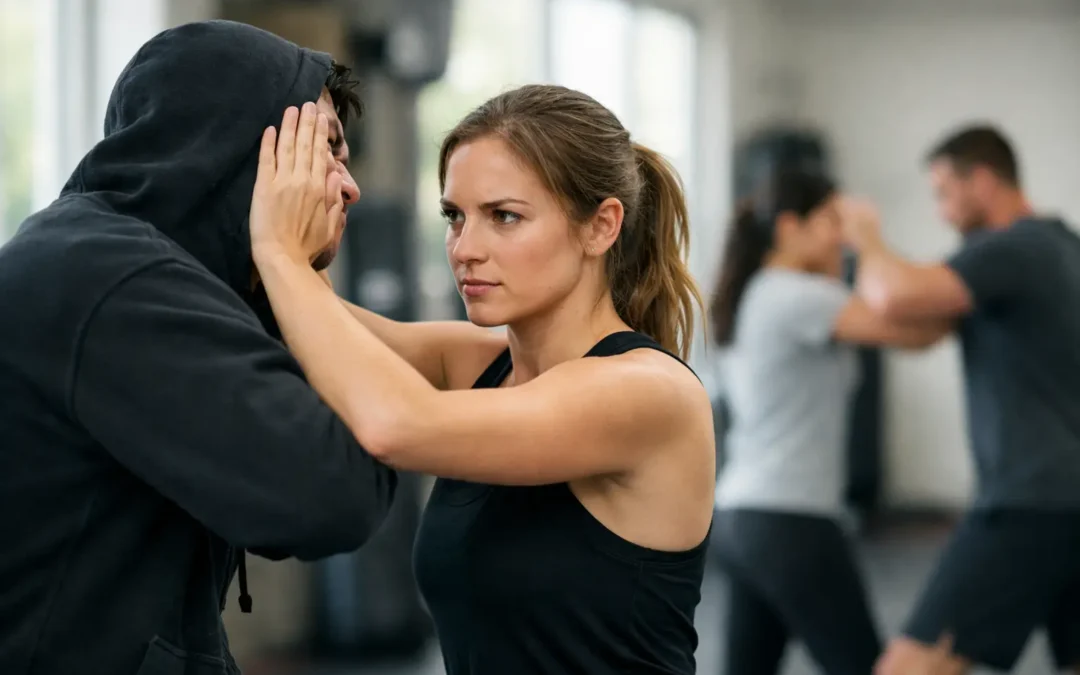
A woman should not have to learn self defence simply to move through daily life without worry. The responsibility for harassment, intimidation and violence always sits with the person causing harm. Yet when people ask, “do women need self defence?”, they are often asking something more practical: could training help me feel more confident, aware and capable if a situation becomes unsafe?
For many women, the answer is yes – not because training makes someone invincible, and not because it removes risk, but because it provides useful options. Good self-defence training develops the ability to notice problems earlier, set clear boundaries, make decisions under pressure and create an opportunity to get away. It can also be a powerful route to better fitness, stronger posture and greater self-belief.
Do women need self defence to feel safer?
No woman needs to prove she is tough enough to deserve safety. Nor should self-defence be sold as a guarantee that nothing bad will happen. Real situations are unpredictable, and the safest outcome is always to avoid physical confrontation where possible.
However, learning self-defence can reduce the feeling of helplessness that many people carry. It replaces vague advice such as “be careful” with skills you can practise: using your voice, recognising distance, moving with purpose, protecting yourself when close contact cannot be avoided and leaving when a route opens.
That distinction matters. Self-defence is not about winning a fight or trying to overpower another person. It is about making choices that improve your chance of getting to safety. For some women, that starts with confidence to say no. For others, it means learning what to do if someone grabs an arm, crowds their space or ignores a clear boundary.
Self-defence is more than striking techniques
A useful programme teaches more than punches and kicks. Kickboxing can build balance, coordination, power and fitness, all of which support practical self-protection. But technical skill works best alongside awareness, assertiveness and sensible decision-making.
Awareness does not mean living in a state of fear or constantly assuming the worst of people. It means being present. Looking up rather than walking while absorbed in a phone, trusting discomfort when somebody is acting strangely, knowing where the exits are and giving yourself room around people who are making you uneasy are all practical habits.
Verbal confidence matters too. Many women have been taught to soften their words, avoid appearing rude or keep the peace at their own expense. In an uncomfortable situation, a firm, audible “No”, “Stop” or “Back away” can draw attention, establish a boundary and create a moment to move. Training gives you a safe place to practise that voice until it feels natural.
Physical techniques have their place, but they should be simple enough to remember under stress. Complicated sequences may look impressive in a demonstration, yet pressure changes everything. A strong self-defence class focuses on straightforward movements, body positioning, breaking free from common holds and creating enough space to escape. The aim is not perfection. It is a practical response you can use when adrenaline is high.
Why regular training makes a difference
A one-off workshop can introduce useful ideas, especially around personal safety and boundary setting. But confidence is built through repetition. The first time someone practises a loud command, a pad strike or an escape from a grip, it can feel unfamiliar. Over time, that awkwardness becomes familiarity, and familiarity can make it easier to respond decisively.
Regular martial arts training also teaches people how their bodies move. You learn to stand with better balance, generate force safely and stay composed while working hard. You become used to being challenged in a controlled environment. That does not recreate a real confrontation, but it can reduce the shock of physical pressure and help you think more clearly.
There is a wider benefit as well. Women often start kickboxing or self-defence because they want to feel safer, then discover they enjoy feeling stronger. Training can become protected time in the week: time to improve fitness, release stress, meet supportive people and work towards goals that are entirely your own.
At Kane Academy, women’s training is designed to be welcoming for complete beginners as well as those returning to exercise. Nobody needs previous martial arts experience to start. The most valuable first step is simply walking into a supportive class and giving yourself permission to learn.
What good women’s self-defence training should feel like
The right class should challenge you without trying to frighten or embarrass you. Self-defence is serious, but learning it does not need to be harsh. Coaches should explain why a technique is being taught, demonstrate it clearly and make space for questions. You should never feel pressured to practise at a level that does not feel appropriate for you.
A positive training environment recognises that people arrive with different experiences. Some women want a new way to get fit. Some have had an unsettling incident and want to regain confidence. Others want practical skills before travelling, starting university, working late or spending more time independently. A good coach meets people where they are and helps them progress at a sensible pace.
Look for structured teaching rather than random drills. Classes should build foundations first: stance, movement, striking safely, awareness and simple responses to common situations. As confidence grows, students can develop their fitness and technique while learning how those skills fit into realistic self-protection.
Training with partners must be handled carefully. Controlled practice is useful because it teaches range, timing and how to respond to another person’s movement. But consent and communication are essential. A respectful class will establish clear boundaries, use suitable protective equipment and ensure partners work at an appropriate intensity.
The trade-offs: confidence without false certainty
Self-defence training is worthwhile, but honesty matters. No technique works every time. Size, strength, surprise, surroundings, stress and the actions of another person can all affect an outcome. That is why the best training avoids bold promises and teaches layers of protection instead.
The first layer is prevention where possible: trust your instincts, avoid escalating conflict and leave early if something feels wrong. The next is communication: clear boundaries, a confident voice and getting help from people nearby. Physical action is the final layer, used to protect yourself and make an escape when there is no safer option.
This approach is not about blaming women for the behaviour of others or suggesting they must train to earn independence. It is about offering skills that can sit alongside everyday freedom. Learning to defend yourself should expand your confidence, not shrink your life around fear.
Starting as a complete beginner
You do not need to be naturally sporty, flexible or fearless to begin. Most people feel nervous before their first class, particularly if they have never thrown a punch or exercised in a group before. That feeling usually passes quickly when the session is structured and the people around you are supportive.
Wear comfortable clothes, arrive ready to learn and focus on small improvements. Your first session may teach you how to stand, move, strike pads or use your voice with conviction. Those basics are not small at all. They are the building blocks for confidence that carries into work, travel, social situations and everyday life.
The goal is not to become a different person. It is to recognise that you already have a right to take up space, set boundaries and act when something does not feel right. A good self-defence class gives that belief practical shape – one lesson, one repetition and one stronger decision at a time.